Famous Sweets of Dwarka: The Peda, the Ghughra and What Every Pilgrim Carries Home
No Dwarka yatra is complete without returning home with a box of Dwarkadhish Peda. From the iconic khoya-based Peda sold outside both temple gates to the crispy Ghughra, the saffron-laced Basundi, and the thick Shrikhand of Gujarati thali restaurants, Dwarka's sweet tradition is as old as the pilgrimage itself. This guide covers every sweet you will encounter, what to buy, and what to leave behind.
Useful References
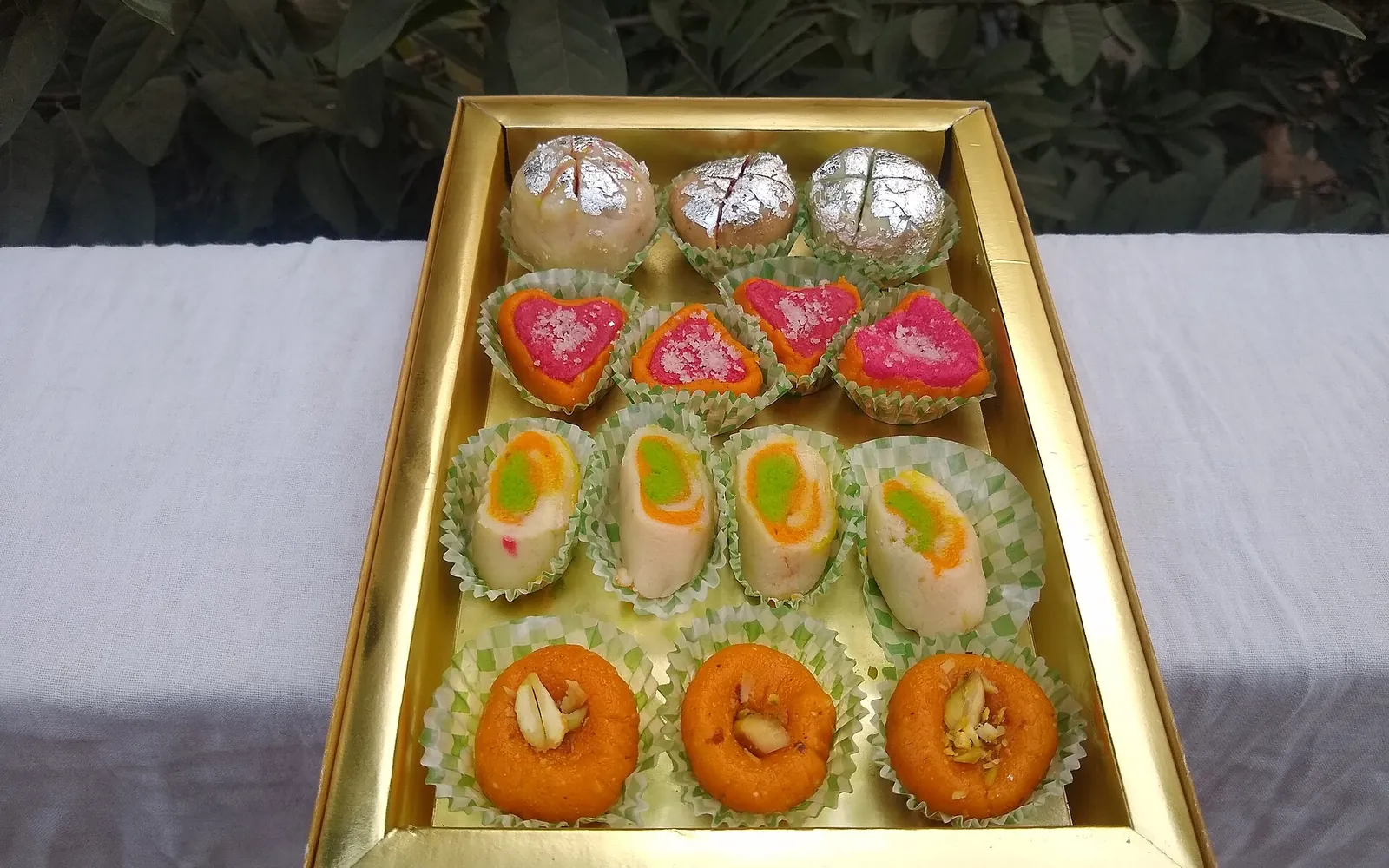
Dwarkadhish Peda: The Signature Sweet of Dwarka Yatra
If there is one sweet that has become inseparable from the Dwarka pilgrimage, it is the Dwarkadhish Peda. Every pilgrim who completes the Char Dham yatra at Dwarkadhish Temple returns home carrying at least one box, often several, one for the family, one for the neighbours, one for colleagues at work. This simple, soft, milky sweet has become the edible symbol of the Dwarka yatra, the food-form of the blessings that pilgrims carry back from the abode of Lord Dwarkadhish.
The Peda is made from khoya, milk that has been reduced over a slow flame for hours until most of the water has evaporated and only dense, rich milk solids remain. The khoya is then kneaded with sugar and flavoured generously with ground cardamom. Some shops add a small quantity of saffron to the mixture, giving the Peda a light golden or pale yellow hue that distinguishes it from the plain ivory-white variety. The mixture is shaped by hand into small, slightly flattened rounds, each about the size of a large coin. The texture is soft and slightly granular from the sugar, with a milky fragrance that is clean and not overly sweet.
It is important to understand that Dwarkadhish Peda is distinctly different from the more famous Mathura Peda. Mathura, the birthplace of Lord Krishna, also has its own signature peda, but that version is harder in texture, darker in colour, and more intensely caramelised due to a different preparation method and longer cooking time. The Dwarka Peda is softer, lighter, and more delicate. Pilgrims who have visited both sites will immediately recognise the difference. Neither is superior, they are simply different expressions of the same devotion, shaped by the culinary traditions of different regions of India.
Shops selling fresh Peda are found in the lane immediately outside both the Swarga Dwar (north gate) and the main south-facing gate of Dwarkadhish Temple. There are four to six dedicated sweet shops in this stretch, and most of them keep Peda in open trays near the window so that the fragrance drifts into the lane and attracts pilgrims leaving the temple. A box of 6 pedas typically costs Rs 30–40; a larger box of 12 costs Rs 60–80; and an airtight gift box of 24 pedas runs Rs 80–100. The shops affiliated with the Shri Dwarkadhish Temple Trust are generally considered the most reliable in terms of quality and freshness, as their stock is prepared fresh each morning under trust supervision.
Regarding shelf life: Peda made from pure khoya without preservatives should be consumed within 2–3 days if kept at room temperature. In the heat of a Gujarati summer this window is shorter, consume within a day if travelling without refrigeration in May or June. If you refrigerate the Peda in an airtight container immediately on reaching home, it will remain good for 7–10 days. For long-distance travel, by train or by plane, purchase fresh Peda on your day of departure and pack it in an airtight box with a cool pack if possible. Domestic flights and train journeys are generally within the safe window. Check-in luggage for flights is perfectly acceptable; airlines have no restriction on carrying traditional Indian sweets.
"The tradition of taking Peda home as prasad from Dwarka is centuries old. Even the commercially-sold Peda from the temple lane carries the spiritual weight of the Char Dham, it is distributed to family, neighbours, and colleagues as blessed food from the abode of Lord Dwarkadhish."
Panchamrit: The Sweetest Experience in Dwarka Is Not for Sale
Before discussing any of the commercial sweets of Dwarka, it is necessary to speak about Panchamrit, because no sweet shop item, however fine, can match what Panchamrit represents in the spiritual life of a pilgrim visiting Dwarkadhish Temple. Panchamrit is technically a prasad, not a dessert, and it cannot be purchased from any shop. It can only be received, from the hands of a temple priest, during the ritual of abhishek.
The word Panchamrit means "five nectars" in Sanskrit: panch (five) and amrit (nectar, the divine drink of immortality). The five ingredients are milk, curd (yogurt), ghee (clarified butter), honey, and sugar. Each of the five carries a specific spiritual meaning: milk for purity, curd for prosperity, ghee for strength and victory, honey for sweetness of speech, and sugar for the sweetness of life itself. Together, these five substances are poured over the idol of Lord Dwarkadhish in the ritual of abhishek, the sacred bathing of the deity, and the resulting Panchamrit, now charged with the spiritual energy of that act, is distributed to devotees as mahaprasad.
When a pilgrim receives Panchamrit from the priest, poured from a small vessel or spoon into cupped hands, the liquid is consumed immediately, on the spot. It is not taken home. The experience of tasting this warm, slightly sweet, fragrant mixture, milk and ghee and honey, touched by the Lord, is what many pilgrims describe as the single most spiritually intense moment of their entire Dwarka yatra. No other sweet in the temple market can offer that. If the purpose of your visit is spiritual nourishment, seek the abhishek prasad above all else. The commercial Peda and Ghughra are delicious, but they belong to a different order of experience.
The Six Famous Sweets of Dwarka
Dwarkadhish Peda
Soft khoya rounds with cardamom. The signature souvenir sweet. Found outside both temple gates.
Rs 30–100 per boxGhughra
Deep-fried half-moon pastry filled with coconut, sugar, cardamom and dried fruits. Crispy and fragrant.
Rs 10–20 per pieceBasundi
Thick sweetened reduced milk with saffron strands, cardamom and pistachios. Best served warm.
Rs 30–50 per portionShrikhand
Hung curd sweetened with sugar, saffron and cardamom. The kesar-elaichi variant is most common.
Rs 20–40 per portionLadoo
Besan or coconut ladoo offered in prasad sets and temple-associated ceremonies.
Part of prasad thaliPanchamrit
Five-nectar sacred mixture. Received as prasad during abhishek. Not for sale anywhere.
Temple prasad onlyBasundi: Dwarka's Richest Sweet Dessert
Basundi is one of the great sweets of Gujarati cuisine, and in Dwarka it appears on almost every restaurant menu and in sweet shops throughout the temple market. To understand Basundi is to understand the patience and richness of traditional Indian milk-based sweets. It is made by simmering whole milk over a low flame for an extended period, often two hours or more, stirring continuously until the volume reduces to less than half and the texture transforms from thin and liquid into something thick, creamy, and almost custard-like. Sugar is then added, followed by freshly ground cardamom for fragrance, and, in the finest versions, a few strands of kesar (saffron) that dissolve into the warm milk and leave both their golden colour and their distinctive floral aroma behind. Slivered pistachios and occasionally almonds are scattered on top before serving.
The result is a dessert that is simultaneously light and deeply satisfying. Unlike a kulfi or an ice cream, Basundi does not rely on coldness for its appeal, in fact, the best Basundi in Dwarka is served at room temperature or slightly warm, which allows the full fragrance of the cardamom and saffron to be experienced. Chilling it suppresses the aromatics and dulls the pleasure. Pilgrims visiting temple-market restaurants in Dwarka will find Basundi listed as a dessert at the end of a Gujarati thali, priced at Rs 30–50 for a small katori (bowl). Sweet shops in the temple lane also sell it packaged in small sealed containers, though the freshly made version from a restaurant always surpasses the pre-packaged variety.
Basundi is not well suited to being carried long distances as a souvenir, it is a refrigeration-dependent food that loses quality within a few hours at room temperature. If you want to taste authentic Basundi, eat it fresh in Dwarka.
Ghughra: The Crispy Half-Moon Sweet of Gujarat
Ghughra is a sweet that is so tied to Gujarati culture that it appears at every important occasion, Diwali, Janmashtami, weddings, and religious celebrations. In Dwarka, where the festival calendar is dense with religious observances, Ghughra is available year-round in the sweet shops near the temple. It is a deep-fried pastry shaped like a half-moon, the Hindi name ghughra comes from the curved, crescent shape of the sealed pastry, and it is filled with a fragrant mixture that typically combines grated coconut (fresh or desiccated), powdered sugar, cardamom, and dried fruits such as raisins and finely chopped cashews. Some variations include a small amount of mawa (khoya) in the filling for additional richness.
The preparation of Ghughra is a labour of love. A thin dough of wheat flour and ghee is rolled into small circles, a teaspoon of filling is placed at the centre, the circle is folded in half, and the edges are sealed and crimped by hand into a decorative pattern. The finished pieces are deep-fried in oil or ghee until golden brown and then cooled before serving. The exterior is crispy and light, providing a satisfying crunch that gives way to the warm, sweet, fragrant filling. In some Saurashtra-region variations, the filling has a faintly savoury edge from the coconut and a touch of rock salt, making it a sweet-savoury experience rather than purely sweet.
Ghughra from Dwarka sweet shops costs approximately Rs 10–20 per piece. Unlike Peda, Ghughra is a dry sweet and travels considerably better, a sealed box of Ghughra can remain fresh at room temperature for three to five days, making it a practical souvenir choice for pilgrims travelling long distances by train. It is also a crowd-pleaser: unlike the milky delicacy of Peda, which some people find too mild, Ghughra's texture contrast and coconut filling tend to be universally appreciated.
"Ghughra is the dry sweet to pack for the journey home. It travels better than Peda and the crispy texture survives train journeys without refrigeration for up to three to five days."
Shrikhand: Gujarat's Beloved Hung-Curd Sweet
Shrikhand is one of the most beloved sweets in all of Gujarati cooking, and no pilgrim visiting Dwarka should leave without tasting it at least once in a local thali restaurant. It is made by hanging fresh yogurt (curd) in a muslin cloth for several hours until most of the whey drains away, leaving behind a thick, dense, creamy mass called chakka. This chakka is then mixed thoroughly with powdered sugar, ground cardamom, and, in the version most commonly encountered in Dwarka, a generous pinch of kesar (saffron), which gives the Shrikhand its characteristic pale golden-orange colour and its floral, faintly honey-like aroma. This version is known as Kesar-Elaichi Shrikhand and is the most popular variety across Gujarat.
The taste of good Shrikhand is extraordinary, it is simultaneously tangy (from the curd base), sweet (from the sugar), and fragrant (from the cardamom and saffron). The texture is thick enough to be scooped with a spoon but not quite as solid as a cheesecake, somewhere between thick yogurt and cream cheese in consistency. In a Gujarati thali in Dwarka, Shrikhand arrives in a small stainless-steel katori alongside the puri and the other sweet components of the meal. It is usually eaten last, scooped up with pieces of puri (fried flatbread) in the traditional Gujarati style. This combination of puri and Shrikhand is one of the most satisfying and iconic pairings in Indian cuisine.
Shrikhand is available in sweet shops near the temple in small sealed plastic containers, priced at Rs 20–40 per portion. However, it requires refrigeration and is best consumed within a day or two of purchase. For pilgrims looking to bring it home, it is practical only for very short journeys with refrigeration access. The wiser choice is to eat it fresh in Dwarka and carry Peda or Ghughra as the travelling souvenir.
Ladoo: The Prasad Thali Sweet
Ladoo in Dwarka occupies a more ceremonial space than the commercial sweets sold in the temple market. You are less likely to encounter ladoo as a standalone purchase and more likely to find it as part of a prasad thali or as part of a set of offerings associated with specific temple ceremonies or puja packages. The most common varieties found in the Dwarka area are besan ladoo, made from roasted chickpea flour, ghee, and sugar, with a faintly nutty, caramelised flavour, and coconut ladoo, made from desiccated coconut, condensed milk (or khoya), and cardamom. Both are round, dense, and satisfyingly sweet.
During major festivals, Janmashtami, Govardhan Puja, and other significant days in the Vaishnava calendar, the temple and associated religious organisations distribute ladoo as a part of the mahaprasad offering to all devotees who visit. This ladoo-as-prasad carries significant spiritual weight in the Vaishnava tradition, and devotees who receive it treat it with the same reverence as the panchamrit. For ordinary pilgrims visiting on non-festival days, ladoo can be found in sweet shops as part of a mixed sweet box that might include Peda, Ghughra, and ladoo together, a good option if you want to bring home a variety rather than a single sweet.
Where to Buy Sweets in Dwarka
- Temple Lane (Best) 4–6 shops in the lane from Swarga Dwar to the main road; freshest stock, made daily
- Temple Trust Shops Most reliable quality; stock prepared under temple trust supervision each morning
- Main Bazaar Shops Independent sweet shops; check for fresh Peda being made, visible through shop window
- Restaurant Dessert Counter Best place for Basundi and Shrikhand; eat fresh, do not pack these for travel
- Avoid Pre-packaged "Dwarka sweets" from vendors far from the temple, quality is inconsistent
- Avoid Sweets with unnaturally bright synthetic colours; genuine Dwarka sweets are pale and natural in colour
How to Carry Dwarka Sweets Home
Carrying Dwarka Peda home is a practical matter that every pilgrim has to navigate, and the sweet shop owners near the temple are experienced in advising travellers. The first and most important step is to buy sweets on the day you depart rather than one or two days before, especially in summer. Fresh Peda has the best shelf life, and the clock starts ticking once the sweet is made. If you are departing Dwarka by train or bus in the morning, buy your Peda the previous evening from a shop that has had fresh stock arrive that afternoon. If you are departing in the afternoon, buy your Peda that same morning.
For packaging, choose boxes with airtight lids rather than open trays covered with wax paper. Most temple-lane shops sell Peda in neat cardboard or plastic boxes with secure lids. Ask for the airtight version specifically if you are travelling more than six hours. Stack the boxes flat in your bag rather than on their side to prevent the pedas from moving and breaking. For Ghughra, a sealed tin box or airtight plastic container is ideal, the crispy pastry can absorb moisture and soften if left in humid conditions.
-
1
By Train
Sweets in airtight boxes are perfectly fine in train compartments. Place them in overhead racks, away from direct sunlight through windows. Peda lasts the full journey on trains up to 24–36 hours.
-
2
By Flight (Check-in)
Airlines allow sweets in check-in luggage without restriction. Pack in a rigid container to prevent crushing. A cool pack in the bag helps in summer.
-
3
By Flight (Cabin Bag)
Sweets are allowed in cabin bags on domestic Indian flights. Use an airtight sealed box to prevent the scent from spreading through the cabin.
-
4
On Arrival
Refrigerate Peda in an airtight container immediately on reaching home. Consume within 7–10 days. Ghughra can be kept at room temperature for 3–5 days in a sealed box.
The Spiritual Meaning of Dwarka Sweets
In the context of Hindu pilgrimage, food is never merely food. The sweets sold in the lane outside Dwarkadhish Temple occupy a unique position, they are commercial goods in the worldly sense, but they are understood as prasad (blessed offering) by the devotees who purchase them. The proximity to one of the four sacred dhams of Hinduism is believed to imbue even the commercial sweets of the temple market with spiritual significance. A Peda purchased from a shop ten steps from the gate of Dwarkadhish Temple is not the same, in the devotee's understanding, as an identically made Peda purchased from a sweet shop in any other city.
This spiritual dimension explains a social custom that is unique to Char Dham yatra towns: the obligation, or rather the deep desire, to bring sweets home for every person in one's circle. A pilgrim returning from Dwarka does not bring Peda merely as a souvenir or a food gift. They bring it as a form of distributed blessing, a way of sharing the spiritual merit of the pilgrimage with those who could not make the journey. Family members, neighbours, colleagues, and even casual acquaintances receive a piece of Peda with the understanding that it comes from the hands of Dwarkadhish, touched by the proximity of the divine. In this sense, the commercial Peda of the temple lane becomes a carrier of the sacred, and the tradition of taking it home is as ancient as the pilgrimage itself.
"Even the commercially sold Peda from the temple lane is understood as prasad by devotees, it is distributed to family, neighbours, and colleagues as blessed food from the Char Dham. The spiritual merit of the yatra travels home in that small box."
Frequently Asked Questions
Also Explore Dwarka
Dwarka Food Guide
Complete guide to pure veg restaurants, prasad, and street food in Dwarka.
Read Food GuideDwarkadhish Temple
Full guide to the main temple, darshan timings, aarti, history and puja.
Read Temple GuideGomti Ghat Dwarka
The sacred river ghat, evening aarti, rituals, and what to see.
Explore Gomti Ghat