What to Eat in Dwarka: The City Is Vegetarian and the Food Is Excellent
Dwarka is a pilgrimage city, within 1 km of Dwarkadhish Temple you will not find a single non-vegetarian restaurant. This is not a rule written anywhere; it is simply the nature of the city. Pilgrims arrive with a sattvic mindset and the food ecosystem has evolved to match. From a Rs 20 Fafda-Jalebi breakfast beside Gomti Ghat to a full Gujarati thali at Rs 80-150, Dwarka feeds its pilgrims well.
Useful References
Why Dwarka Is Entirely Vegetarian
Dwarka is one of the four sacred Char Dhams of Hinduism and the city where Lord Krishna is said to have ruled as king. The presence of Dwarkadhish Temple, the principal deity of the city, has shaped every aspect of daily life in Dwarka, including and especially its food. Within a 1 km radius of the temple, you will not find a single shop, stall, or restaurant selling non-vegetarian food of any kind. No chicken. No fish. No eggs. Nothing. This is not a law that has been passed or a rule that is enforced by officials. It is simply the nature of the place. Pilgrims arrive carrying a sattvic frame of mind, the desire to be pure in body and spirit for their darshan, and the food ecosystem of the city has evolved entirely to serve that intention.
What you will find instead is some of the most flavourful, diverse, and satisfying vegetarian food in Gujarat. The cuisine of this region is naturally sweet, spiced, and rich in texture, gram flour forms the base of Fafda and Kachori; lentils go into Dabeli filling and dal; yogurt is the foundation of kadhi and chhaas. The cooking oil is clean and the frying is fresh. The sweet tooth of Gujarat is everywhere, even a savoury breakfast comes with Jalebi. For a pilgrim, eating in Dwarka is not an act of sacrifice or compromise. It is one of the quiet pleasures of the journey.
"Within 1 km of Dwarkadhish Temple you will not find a single non-vegetarian restaurant. This is not a rule written anywhere, it is simply the nature of the city."
Fafda-Jalebi: The Dwarka Breakfast
If you do one food thing in Dwarka, let it be this: wake up early for darshan, walk to Gomti Ghat, and eat Fafda-Jalebi at a stall with the river in front of you. This is the quintessential Gujarat morning and Dwarka does it as well as anywhere in the state.
Fafda is made from gram flour (besan) that is kneaded into a stiff dough, seasoned with carom seeds, turmeric, and a little chilli, then pressed through a mould or rolled by hand into long flat strips and deep-fried until crispy and golden. The texture is a particular pleasure, firm but not brittle, with a savoury chickpea depth and a slight crackle when you bite into it. It is eaten with a bright green chutney made from fresh coriander and mint, and often accompanied by a small raw papaya salad dressed with lemon and green chilli. The papaya salad is not an optional garnish, it is an essential contrast that cuts the richness of the fried flour.
Jalebi is the sweet counterpart. Batter is piped in tight spirals into hot oil, fried until crispy, then immediately submerged in warm sugar syrup where it absorbs a soak and becomes simultaneously crispy on the outer coils and syrupy within. The combination of Fafda and Jalebi, savoury-crispy and sweet-syrupy, hot from the pan, eaten together, is one of the great morning food pairings anywhere in India. A generous portion of both costs Rs 20-30 at Gomti Ghat stalls. Stalls open from 6 AM and are busiest between 6:30 and 8 AM, before the morning temple crowd disperses. Eat them hot, Fafda loses its crispiness as it cools and Jalebi begins to lose its syrup as the sugar crystallises.
- What it is Crispy gram flour strips (Fafda) + spiral sugar-soaked sweets (Jalebi)
- Price Rs 20–30 for a generous portion of both
- Timing Stalls open from 6 AM, busiest 6:30–8 AM
- Where Gomti Ghat area and main market lane
- Served with Green chutney (coriander-mint) and raw papaya salad
- Key tip Eat immediately, Fafda loses crispiness quickly once cooled
Dabeli: The Kutchi Snack That Conquered Gujarat
Dabeli originated in the Kutch region of Gujarat and has since spread to every corner of the state. In Dwarka, it is the most popular mid-morning and afternoon snack, sold at stalls near Gomti Ghat and in the market lane near Swarga Dwar. A single Dabeli costs Rs 10-15, which makes it an ideal and affordable bite between temples.
The filling is a spiced potato mixture: boiled potato is mashed and cooked with a special Dabeli masala, a complex spice blend containing coriander, chilli, cumin, and a hint of sweetness, along with tamarind and date chutney. The finished filling is topped with pomegranate seeds, fine sev (thin crispy gram flour noodles), roasted peanuts, and finely chopped onion. This entire mixture is placed in a ladi pav, a soft, slightly sweet white bread bun, that has been lightly toasted on a tava with butter. The contrast of textures in a good Dabeli is what makes it so satisfying: the smooth potato filling, the crunch of the peanuts and sev, the burst of juice from the pomegranate, and the soft resistance of the bun. It is not filling enough to constitute a meal but it is exactly what you want between the rigour of temple darshans and the heat of a Gujarat afternoon.
The Gomti Ghat area consistently has the best Dabeli stalls in Dwarka. The vendors here have been making Dabeli for years and the quality of their masala and their filling-to-bun ratio is noticeably better than at the bus stand stalls, which cater to a more transient crowd.
Kachori: Fried Pastry for Afternoon Hunger
Kachori is a deep-fried pastry with a flaky outer shell and a spiced filling inside. It is heavier and more substantial than Dabeli, making it a better choice for an afternoon snack or a quick light lunch when you do not have time for a full thali sitting. In Dwarka you will find three main varieties.
-
1
Gujarati Moong Dal Kachori
The local version uses a filling of whole or split moong (green lentil) that has been soaked, drained, and cooked with fennel seeds, ginger, and green chilli. The shell is made from refined flour and shortening, fried slowly until puffed and golden. This is the Dwarka staple, available at most stalls and bakery-style shops. Rs 15-20 each.
-
2
Rajasthani Dal Kachori
A spicier version with a urad dal (black lentil) filling heavily seasoned with red chilli, fennel, and asafoetida. Popular with pilgrims from Rajasthan, who recognise it from home. Sold at a few stalls near the bus stand. Rs 15-25 each.
-
3
Aloo (Potato) Kachori
The simplest variety, mashed potato seasoned with cumin, coriander, and green chilli as the filling. Soft inside, crispy outside. The most commonly available type at market stalls. Rs 15-20 each.
All three varieties are served with tamarind chutney and sometimes a green coriander chutney on the side. Kachori is best eaten hot and fresh, avoid pre-made kachoris sitting under glass at the counter for several hours, as the pastry becomes soggy and the filling dries out.
Bhajiya and Masala Chai: The Evening Pair
After the afternoon rest and before the Sandhya Aarti, the food of choice in Dwarka is Bhajiya with Masala Chai. This is the universal Indian evening ritual, battered, deep-fried vegetables and strong spiced tea, and Dwarka executes it simply and well.
Bhajiya (known elsewhere in India as pakora) is made by dipping vegetables into a seasoned gram flour batter and deep-frying them until crispy. In Dwarka the most commonly available varieties are onion bhajiya (sliced onion rings in batter, the crispiest and most popular), mirchi bhajiya (whole green chillies dipped in batter, a bold choice for those who can handle the heat), and potato bhajiya (sliced potato circles, thicker and more filling than the other two). A portion of 4-6 pieces costs Rs 10-20. Vendors near the market lane and Gomti Ghat have the highest turnover and therefore the freshest oil and crispiest results. Bhajiya is a monsoon staple everywhere in Gujarat, the smell of batter hitting hot oil on a rainy evening is as evocative as any other sensory memory of a Gujarat pilgrimage.
Masala Chai in Dwarka is made the Gujarat way: strong, milky, and spiced with ginger, cardamom, and cloves, simmered together until the flavours are fully blended into the tea. It is served in small glasses, some stalls still use the traditional kulhad (clay cup) which gives a faint earthen flavour to the tea. A glass costs Rs 10-15. The stalls along the steps of Gomti Ghat are particularly good for chai, you can sit on the ghat steps, watch the Gomti River below, and drink your tea while the late afternoon light changes before the aarti. This is one of the small, unhurried pleasures of a Dwarka pilgrimage that no itinerary can fully plan for you.
"Sit on the steps of Gomti Ghat with a Rs 15 glass of Masala Chai and watch the river. No restaurant meal in Dwarka will give you this."
Gujarati Thali: The Complete Pilgrim Meal
For a sit-down meal that covers every nutritional and flavour requirement of a pilgrim's day, the Gujarati thali is the right choice. It is the most filling, the most varied, and the best value for money of anything you can eat in Dwarka.
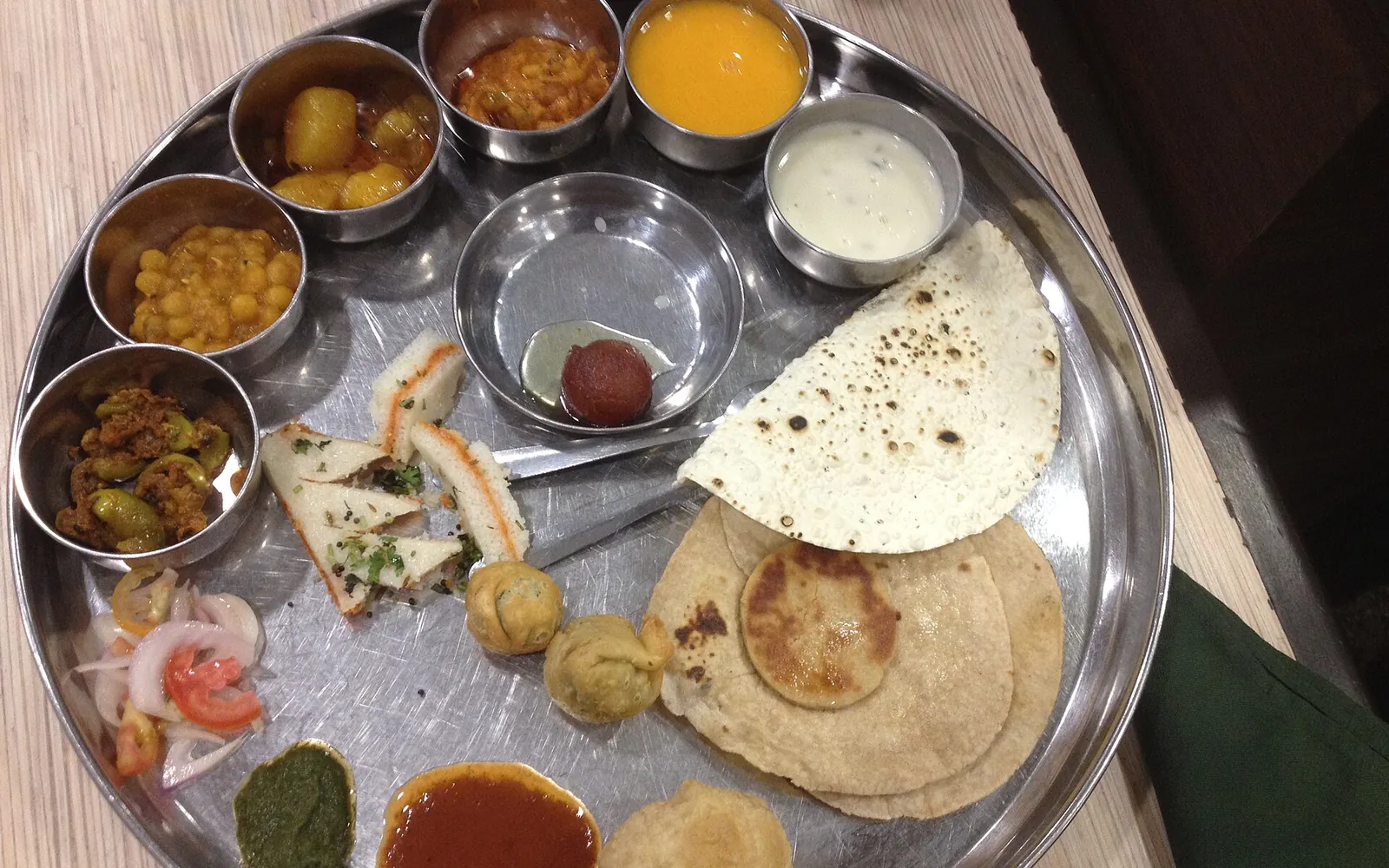
A full Gujarati thali arrives on a large steel plate lined with small katoris (bowls). The standard contents: dal (a thin lentil soup, mildly spiced), kadhi (a distinctly Gujarati preparation, a warm, slightly sweet and slightly sour curry made from buttermilk and besan, tempered with mustard seeds, curry leaves, and ginger), two or three sabzis (seasonal vegetable preparations, you might get undhiyu, batata nu shaak, or ringan no olo depending on the season), roti and chapati (thin wheat flatbreads, freshly made), rice, papad (thin crispy lentil wafers), salad, and chhaas (buttermilk, lightly spiced with cumin and coriander, the ideal digestive after a heavy meal). The sweet course is usually shrikhand (thick, strained, sweetened yogurt flavoured with saffron and cardamom), gulab jamun, or a seasonal fruit dessert. Most thali restaurants in Dwarka offer unlimited refills on roti, dal, and sabzi at no extra cost, the server comes around repeatedly and you simply nod or hold out your plate.
Cost: Rs 80-150 at restaurants near Dwarkadhish Temple. The market lane behind the temple bazaar has several reliable options. The ideal time for thali is 11:30 AM to 1:00 PM, just before or at the start of the temple's midday closure. Restaurants are busiest between noon and 2 PM, arrive early for a shorter wait and fresher preparations.
- Includes Dal, Kadhi, 2-3 Sabzis, Roti, Chapati, Rice, Papad, Salad, Chhaas, Sweet
- Price Rs 80–150 at restaurants near Dwarkadhish
- Refills Unlimited on roti, dal, sabzi at most establishments
- Best timing 11:30 AM–1 PM for freshest preparations and shorter wait
- Sweet options Shrikhand, Gulab Jamun, or seasonal fruit dessert
- Where Market lane behind temple bazaar and Dwarka Bazaar road
Dal Baati Churma and Khaman Dhokla
Beyond the core Gujarati street food and thali, two other dishes deserve a mention for pilgrims with specific appetites.
Dal Baati Churma is a Rajasthani dish that has found a firm footing in Dwarka, partly because a significant proportion of Dwarkadhish Temple's pilgrims come from Rajasthan. The dish has three components: Baati is a round, hard wheat ball baked in a tandoor or oven until the outside is firm and the inside is cooked through, then split open and submerged in warm ghee. Dal is a Panchmel dal, a mixture of five lentils (moong, chana, urad, toor, masoor) cooked together with tomato and spices into a thick, rich consistency. Churma is the sweet element: the cooked wheat dough is broken up, mixed with ghee and jaggery or sugar, and sometimes flavoured with cardamom and dry fruit. The three together make a complete and extremely satisfying meal, heavier than a Gujarati thali and more festive in character. In Dwarka it is most commonly available at restaurants catering to Rajasthani pilgrim groups and costs Rs 80-120. It is filling enough that you will not need to eat again for several hours.
Khaman Dhokla is the ideal light option between heavy temple darshans. It is a steamed cake made from fermented gram flour batter, the fermentation gives it a slight sourness and a spongy, airy texture. Once steamed and cut into squares, it is tempered with a tadka of mustard seeds, curry leaves, green chilli, and a touch of sugar in oil, then topped with fresh coriander and grated coconut. It is light, digestible, low in oil, and satisfying in small quantities. A portion of 4-6 pieces costs Rs 20-30 and is found at most Gujarati snack shops in the market area. For pilgrims doing multiple darshans in a single day, Khaman Dhokla is the smart mid-morning or mid-afternoon choice, substantial enough to sustain energy but light enough not to weigh you down before the next temple.
Where to Eat: Street Food Geography of Dwarka
Dwarka's food scene is concentrated in three zones, each with a slightly different character and customer base.
-
1
Gomti Ghat Area
The most casual and atmospheric food zone in Dwarka. Stalls here are small, open-air, and morning-focused. Fafda-Jalebi, Masala Chai, and fresh coconut water are the staples. Prices are the lowest in the city. The ghat steps themselves are an ideal place to sit with your chai and watch the river. Best visited between 6 AM and 9 AM and again in the late afternoon before Sandhya Aarti.
-
2
Market Lane near Swarga Dwar
The main commercial food street of Dwarka. A mix of stalls and small sit-down restaurants, operating from early morning through to 10 PM. All the major street foods are available here, Dabeli, Kachori, Bhajiya, Pani Puri, alongside sweet shops selling Peda, Basundi, and Ghughra. This is the best zone for a full lunch thali. Slightly more expensive than Gomti Ghat but more variety and more comfortable seating options.
-
3
Bus Stand Area
The most utilitarian food zone, quick bites for the GSRTC bus crowd arriving and departing. Idli-Vada, samosa, and packaged biscuits dominate here. Food quality is more variable than the other two zones. Useful if you are catching an early morning or late night bus and need something fast. Not recommended as a primary food destination.
Timing Your Food Around the Darshan Schedule
The darshan schedule at Dwarkadhish Temple determines the rhythm of the entire day in Dwarka. Planning your meals around it means you will eat at the right time and avoid the worst of the crowds at both the temple and the restaurants.
- 6:00–7:00 AM Fafda-Jalebi at Gomti Ghat after early morning darshan or ghat walk. Stalls open at 6 AM.
- 11:30 AM Temple Trust Bhojnalaya opens for free lunch. Alternatively, sit-down restaurant thali while the temple is still open. Best to eat before the 12:30 PM closure crowds hit the restaurants simultaneously.
- 1:00–4:00 PM Rest period during midday temple closure. Good time for a full thali lunch and then rest at your accommodation. Most restaurants are at peak capacity noon to 2 PM, you can eat at 1:30 PM when the rush eases.
- 4:00 PM Dabeli or Chai before the temple reopens at 5 PM for Uthapan darshan. Light snack only, save your appetite for dinner.
- 7:30 PM Dinner after Sandhya Aarti. Market lane restaurants, ISKCON Govinda's (closes around 9:30 PM), or your dharamshala. This is the best time for a relaxed evening meal.
"Eating a Fafda-Jalebi breakfast at 6:30 AM by Gomti Ghat, then a full thali lunch at noon, then Dabeli and chai before the 5 PM aarti, and a quiet dinner at 7:30 PM, this is the ideal food day in Dwarka."
Dwarka's Must-Try Dishes at a Glance
Bet Dwarka
Guide to Bet Dwarka island: ferry from Okha, the Sudarshan Setu bridge, seasonal temple timings, and what to see on the island where Krishna lived.
Read Full GuideFafda-Jalebi
The Gujarat breakfast. Crispy gram flour strips and spiral syrupy sweets. Rs 20-30. Gomti Ghat from 6 AM.
Dabeli
Kutchi spiced potato snack in a soft bun with pomegranate, sev, and peanuts. Rs 10-15. Best near Gomti Ghat.
Kachori
Fried pastry with lentil or potato filling. Three varieties: moong dal, Rajasthani dal, aloo. Rs 15-25 with tamarind chutney.
Bhajiya
Battered deep-fried vegetables, onion, mirchi, potato. Evening staple. Rs 10-20 per portion. Market lane and Gomti Ghat.
Gujarati Thali
Complete meal: dal, kadhi, sabzis, roti, rice, papad, chhaas, sweet. Unlimited refills. Rs 80-150 near Dwarkadhish.
Masala Chai
Strong, milky, ginger-cardamom-clove tea. Rs 10-15. Gomti Ghat stalls are the best. Drink on the ghat steps.
Dal Baati Churma
Rajasthani specialty. Wheat balls in ghee with five-lentil dal and sweet churma. Rs 80-120. Filling festive meal.
Khaman Dhokla
Light steamed gram flour cake with mustard-chilli tempering. Rs 20-30. Ideal between heavy darshans.
What to Avoid and Food Safety in Dwarka
Street food in Dwarka is generally safe when eaten at the right stalls. The key principle is to eat at busy stalls with high turnover, fresh oil, freshly made items, and a fast-moving queue are your best indicators of quality. Here are specific things to be careful about.
- Cut Fruit Avoid cut fruit from open carts in summer and monsoon. The exposure to heat and flies makes it a hygiene risk. Buy whole fruit or sealed options instead.
- Pre-made fried items Avoid Kachori or Bhajiya sitting under a glass cover for hours. The pastry gets soggy and the oil can go rancid. Only eat freshly fried items from a stall where you can see the cooking.
- Unknown vendors Small unlabelled stalls at the edge of the bus stand or in the back lanes sometimes use reheated or old oil. The smell of the oil is the tell, fresh oil is neutral, old oil smells sharp and acrid.
- Tap water Do not drink tap water in Dwarka. Use bottled water for drinking and brushing teeth. In summer, carry at least 500ml of water at all times. Small 200ml bottles sold near temples are expensive per litre, buy a 1L bottle from a market shop.
- Gomti River water The Gomti is a sacred river and bathing in it is part of the pilgrimage. Do not drink the river water under any circumstances.
- Storage at sweet shops Peda and milk sweets from shops near the temple gate can sit in open trays for extended periods, especially in summer. Buy fresh from shops that are visibly making or replenishing their sweets regularly.
Frequently Asked Questions
Also Explore
Gomti Ghat Dwarka
The sacred ghat where pilgrims bathe, eat, and watch the aarti.
Explore Gomti Ghat