Dwarkadhish Temple Rules: The Complete List Before You Enter the Char Dham
Dwarkadhish Temple has a clear set of rules that every visitor must follow before entering the main gate. Mobile phones and cameras are not permitted in the sanctum. Leather items must be deposited in the locker. Entry is through Swarga Dwar only and exit through Moksha Dwar. Dress code is enforced. These rules apply to every visitor without exception.
Rules That Surprise First-Time Visitors
Several temple rules catch first-time visitors off guard. The one-way darshan system means you exit through Moksha Dwar, which is on a different side of the temple from where you entered via Swarga Dwar. Many visitors walk back to their footwear deposit point not realising the exit is far from the entrance. Collect a landmark reference before entering. Secondly, all pilgrims join a single general darshan queue, there is no separate VIP lane at Dwarkadhish and no paid pass that lets you skip it, regardless of what touts near the gate or unofficial websites may claim. General darshan has always been free, and everyone from first-time visitors to elderly pilgrims waits in the same line.
- Entering with mobile phone (not deposited at locker)
- Attempting re-entry after exit, not allowed
- Carrying water bottles inside the sanctum
- Touching the deity idols or stepping on the platform
- Sitting on steps inside during peak hours
Photography of the main deity (Lord Dwarkadhish) is not permitted at any time. Photography in the outer courtyard and from the 5th-floor viewing area is allowed. Security checks all bags at both entry gates, the process takes 2–5 minutes per group.
The Complete Rules List
These rules apply to the Dwarkadhish Temple complex including the inner sanctum, the outer courtyard, and the immediate temple premises. They are enforced by temple staff, sevadars (volunteer guides), and security personnel stationed at multiple points inside the complex. None of them are waived for anyone, there is no official VIP or priority-queue scheme at this temple, and none of them can be arranged around in advance, since there is no online booking for darshan here.
Photography Rules: What Is and Is Not Permitted
Photography of the Dwarkadhish deity, the main idol of Lord Dwarkadhish (Krishna) in the inner sanctum, is absolutely prohibited. This is not negotiable and is not relaxed for anyone including journalists, researchers, or VIP visitors. The prohibition exists because in the Vaishnava tradition, the deity is considered a living presence. Photographing the deity is seen as disrespectful, equivalent to taking photographs of a person at prayer without consent.
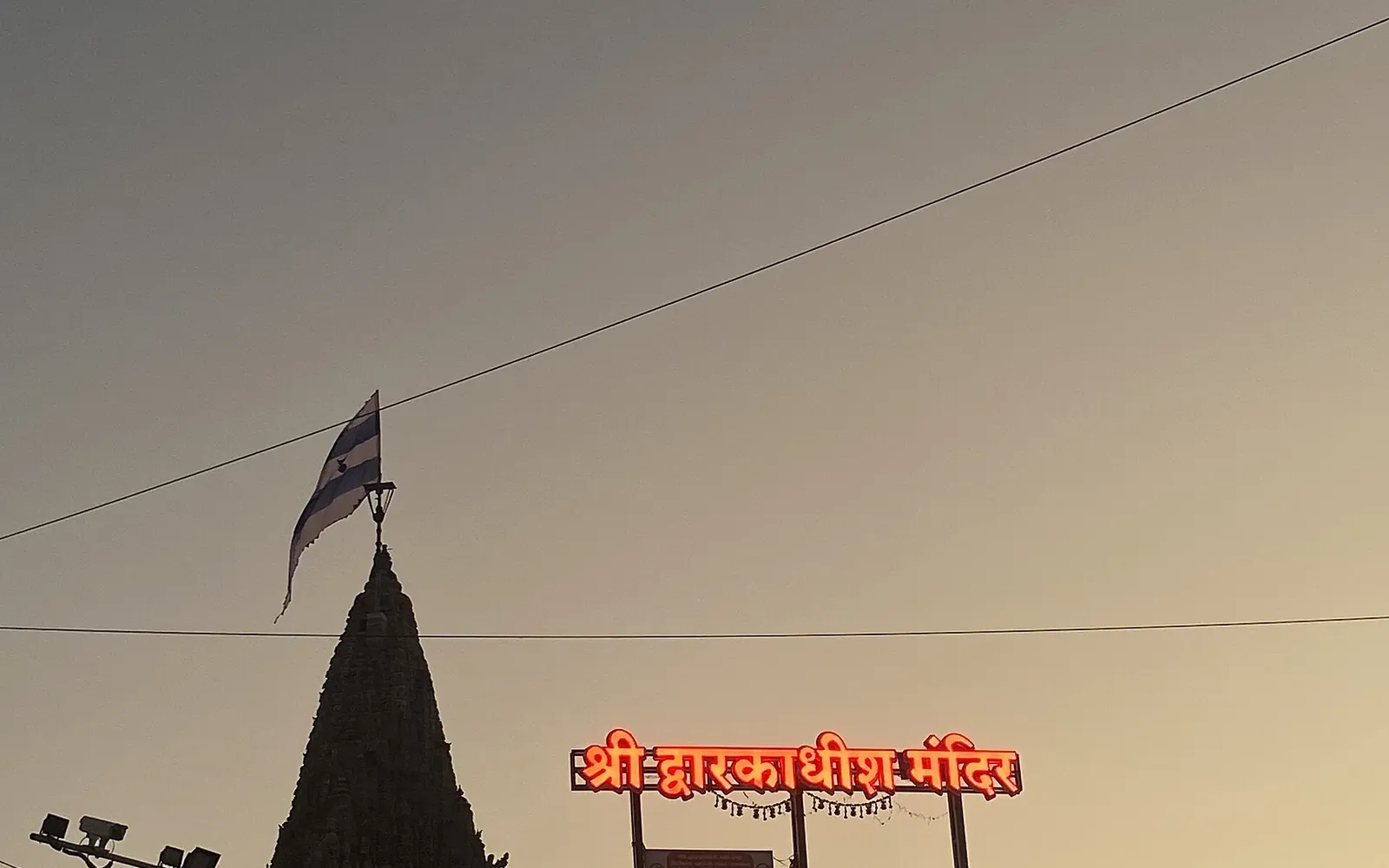
Photography of the temple exterior, the towering 43-metre shikhara (spire) visible from the outside, the Swarga Dwar entrance, the 56-step ghat, is permitted from outside the temple gates. Many visitors photograph the temple from the ghats or from the lane approaching Swarga Dwar. These photographs are entirely allowed. Photography inside the outer courtyard (the paved area between the main gate and the inner sanctum) may be permitted when no aarti is in progress, but the rules are inconsistently applied depending on the volume of visitors and the staff on duty. If in doubt, do not photograph.
The Dhwaja (flag) ceremony at the temple spire happens at 5 AM and sunset daily. The flag change, involving a priest climbing the 43-metre spire to change the saffron flag, is a dramatic event viewable from outside the temple and photographable from the public road or ghat area. This is one of the most photographed aspects of Dwarkadhish and is fully accessible without entering the temple.
The One-Way Darshan Flow Explained
Dwarkadhish Temple manages its visitor flow through a strictly one-directional system. All visitors must enter through Swarga Dwar, the north gate, located at the top of the 56-step staircase on the Gomti River side of the temple. This gate faces north toward the sacred Gomti River. Symbolically, entering through Swarga Dwar (Gateway to Heaven) and exiting through Moksha Dwar (Gateway to Liberation) represents a spiritual journey through the temple.
Moksha Dwar is located on the south side of the temple complex. This is the exit-only gate. Attempting to enter through Moksha Dwar will result in being redirected. The auto-rickshaw and taxi stands recognise this convention, when you ask for Dwarkadhish Temple, a driver will naturally drop you near Swarga Dwar. If you ask specifically for Moksha Dwar, confirm that you need the exit gate (for example, if you want to explore the south side of the temple town first).
The one-way flow serves the practical function of managing thousands of daily pilgrims without creating opposing traffic jams inside the inner corridors. In peak season, this flow is actively managed by temple staff and police who direct pilgrims and prevent backflow. First-time visitors should simply follow the crowd, the flow from Swarga Dwar toward the deity and out through Moksha Dwar is naturally followed by all experienced pilgrims and is self-evident once inside.
Rules at Other Dwarka Temples
The main rules described above, no leather, no mobile in sanctum, no photography, covered dress, apply primarily to Dwarkadhish Temple. Other temples in the Dwarka circuit have varying rules. Rukmini Devi Temple (2.5 km away) has a notable specific rule: non-Hindus and visitors of certain communities may be asked to wait in the outer area rather than entering the inner sanctum. This is a temple-specific tradition and is stated on signboards at the entrance. It does not apply at Dwarkadhish where general access is open to all.
ISKCON Dwarka (3 km away) has its own entrance protocol, you may be asked to sign a brief register and follow specific aarti timing restrictions (certain ceremonies are for initiated devotees only). The main darshan areas at ISKCON are open to all. Nageshwar Jyotirlinga (22 km away) has rules specific to Shaivite temples, Rudrabhishek is performed at restricted times and the inner sanctum has its own queue management. Bet Dwarka island temple has no special restrictions beyond standard dress code and footwear removal.
Frequently Asked Questions
Also Read
Dwarkadhish Temple
Dwarkadhish Temple, the Jagat Mandir and Char Dham site in Dwarka.
Read Full GuideLocker Facility
Dwarkadhish Temple lockers are at both gates, Swarga Dwar and Moksha Dwar.
Read Full GuideDwarkadhish Temple Dress Code
What to wear and what is not allowed, clothing rules for men, women and children visiting the temple.
Read MoreIs Mobile Allowed in Dwarkadhish Temple?
The actual mobile phone rule, where phones are allowed, where they are not, and how to use the locker.
Read MoreDwarkadhish VIP Darshan
Is there really an official VIP pass? What the widely-shared ₹200 claim actually is, and how the general queue really works.
Read More