Rukmini Devi Temple Dwarka: Complete Darshan Guide to Krishna's Queen
Rukmini Devi Temple is one of the most sacred and ancient temples in Dwarka, dedicated to Rukmini, the beloved queen and chief consort of Lord Krishna. Located approximately 2 kilometres from the main Dwarkadhish Temple, this temple is among the few temples in all of India dedicated exclusively to Rukmini and is an essential stop on any Dwarka pilgrimage.
About Rukmini Devi Temple, Dwarka
Rukmini Devi Temple holds the extraordinary distinction of being one of the very few temples in all of India dedicated exclusively to Rukmini, the principal queen of Lord Krishna. While Rukmini is venerated throughout the Hindu world as a manifestation of Goddess Lakshmi, standalone temples bearing her name as the presiding deity are exceedingly rare, making this Dwarka shrine uniquely significant within the larger fabric of Indian pilgrimage culture. For devotees who journey to Dwarka to seek the blessings of Lord Krishna, a visit to Rukmini Devi Temple is not merely a supplementary excursion but an essential and deeply meaningful act of devotion, for it is here that the divine feminine counterpart to the Lord is worshipped in her own right. The temple receives thousands of pilgrims daily and is considered one of the most important shrines in the entire Dwarka religious circuit.
Rukmini was the daughter of Bhishmaka, the king of Vidarbha, and is celebrated across the Puranas as the earthly avatar of Goddess Lakshmi who descended to become the queen of Lord Krishna in his human incarnation. Their divine love story, as narrated in the Bhagavata Purana and the Harivamsa, is one of the most celebrated romances in all of Hindu literature, a tale of a princess so devoted to Krishna that she chose him with complete certainty from among all the princes and kings who sought her hand in marriage. As Krishna's principal queen and chief consort, Rukmini held the highest place among his eight principal wives, known as the Ashtabharyas, and is worshipped for her extraordinary qualities of devotion, patience, grace and selfless love. Pilgrims come to her temple seeking blessings for harmonious marriages, loving relationships and the grace of the divine feminine.
The temple's location on the outskirts of Dwarka city, about 2 kilometres from the main Dwarkadhish Temple, carries its own legendary significance as described in the ancient texts and oral traditions associated with the Harivamsa. According to a widely known legend, the great sage Durvasa, who was renowned for his quick temper and powerful curses, visited Lord Krishna and Rukmini at their palace in Dwarka and requested that they pull his chariot as a form of service to a holy man. During the journey toward the site where this temple now stands, Rukmini became overwhelmed by extreme thirst and, before offering water to the sage as protocol required, drank from a spring she created with her divine power to quench her own thirst first. The furious Durvasa interpreted this as a grave breach of etiquette toward a guest and pronounced a curse that Rukmini would henceforth live separated from Krishna, which is why her temple stands apart from the main Dwarkadhish Temple rather than within the sacred city precincts. This legend explains the temple's placement and adds a poignant dimension to the darshan experience, as devotees here feel the weight of separation and devotion that defines Rukmini's relationship with Krishna in Dwarka. For a complete Dwarka pilgrimage, visiting both the Dwarkadhish Temple and Rukmini Devi Temple is spiritually essential, one offers darshan to the Lord, and the other to the queen who loved him with absolute devotion and bore the pain of separation with extraordinary grace.
"Rukmini Devi, the divine queen of Dwarka, awaits devotees here in her own ancient abode, bestowing her blessings of love, devotion and grace upon all who seek her darshan."
The Legend of Rukmini Haran (Rukmini's Elopement with Krishna)
The story of Rukmini Haran, the dramatic abduction of Rukmini by Lord Krishna on the very day of her planned wedding, is one of the most celebrated episodes in the Bhagavata Purana and stands as one of the great love stories in Hindu religious literature. Rukmini, the incomparably beautiful daughter of King Bhishmaka of Vidarbha, had heard the glories of Krishna from wise men and saints and had fallen deeply in love with him long before they ever met face to face, recognising him as the Supreme Lord who had descended to earth in human form. Her father, however, had arranged her marriage to Shishupala, the king of Chedi, who was an enemy of Krishna and a man Rukmini had no wish to marry. Realising that convention and duty would force her into this marriage against her heart's desire, Rukmini made the extraordinary decision to appeal directly to Krishna with a secret letter. She sent a trusted Brahmin messenger to Dwaraka carrying a letter in which she poured out her devotion to Krishna, declared that she had already accepted him in her heart as her husband, and boldly requested him to come and carry her away from the marriage ceremony before it could be completed. In the letter, she also described a plan, she would visit a nearby temple of Goddess Parvati before the wedding, and that moment of travel outside the fortified city would be Krishna's only opportunity to rescue her. If he did not come, she wrote, she would rather give up her life than marry another.
Krishna, deeply moved by Rukmini's letter and her unwavering devotion, immediately set off from Dwaraka for Vidarbha in his magnificent chariot, arriving precisely as Rukmini emerged from the temple of Goddess Parvati after her prayers. In a breathtaking act of daring witnessed by all the assembled kings and suitors, Krishna swept Rukmini up into his chariot and drove away at great speed. The pursuing armies of Shishupala, Jarasandha and their allies were repulsed by Krishna's brother Balarama and the Yadava forces, and Rukmini's brother Rukmi, who had arranged the match with Shishupala, was defeated and spared his life only at Rukmini's pleading. Krishna and Rukmini were then married in Dwaraka in a ceremony of great splendour, and she became his chief queen, his most devoted consort and the mother of his eldest son Pradyumna. The entire story, the secret letter, the daring rescue, the chariot race, the defeat of rival kings and the triumph of love and devotion, is depicted in magnificent sculptural panels that cover the outer walls of Rukmini Devi Temple, making the temple itself a stone text of this beloved story that pilgrims can read as they circumambulate the shrine. The carvings at the temple are considered some of the finest and most detailed narrative sculpture surviving in Gujarat, and are as much a reason to visit the temple as the darshan of the deity herself.
Architecture of Rukmini Devi Temple
Rukmini Devi Temple is a beautiful and well-preserved example of Chalukya-style temple architecture, the same noble tradition that produced the magnificent Dwarkadhish Temple just 2 kilometres away, and the two temples share a strong family resemblance in the language of their stone carving, proportions and structural organisation. The current structure is dated by art historians and archaeologists to approximately the 12th century CE, though the sanctity of the site is far older and tradition holds that a shrine of some form has stood here since the time of Lord Krishna himself. The temple's shikhara, or main spire, rises with characteristic Chalukya elegance above the garbhagriha, tapering in graceful horizontal bands of carved stone to a finial at its summit, and forms a striking landmark visible from the surrounding landscape of Dwarka. The overall form of the temple, with its mandapa (pillared hall) leading into the sanctum, follows the classical North Indian nagara style of temple construction as it was developed and refined by the master builders of medieval Gujarat.
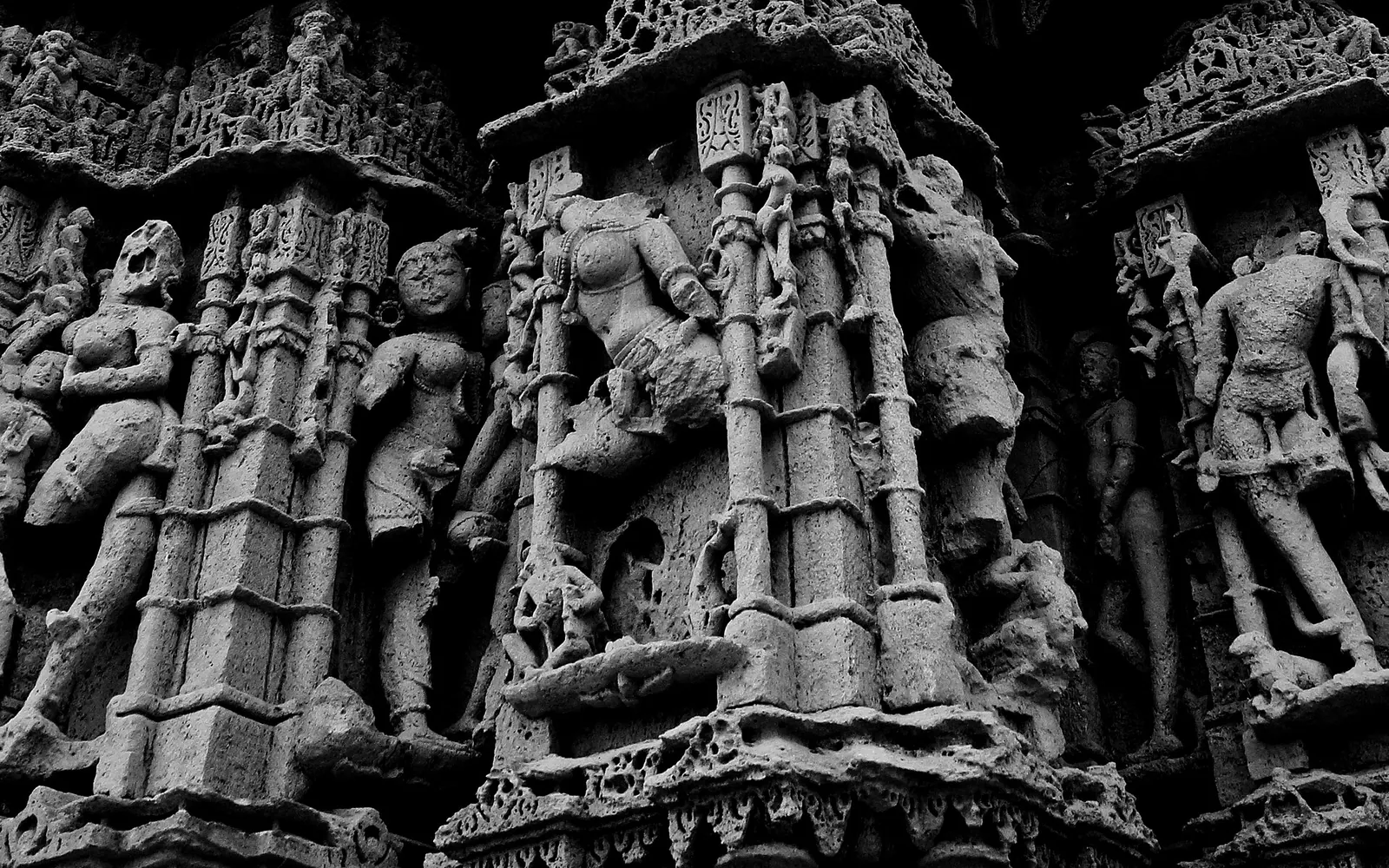
The most visually striking feature of Rukmini Devi Temple is its outer walls, which are covered from base to cornice in exquisitely detailed sculptural panels that constitute a visual narrative of the Rukmini Haran story and other episodes from Lord Krishna's divine life. These carvings, depicting Rukmini writing her secret letter, the Brahmin messenger carrying it to Dwaraka, Krishna and Balarama setting out in their chariot, the gathering of kings at Vidarbha, the dramatic moment of abduction and the subsequent battles, are executed with a narrative clarity and aesthetic refinement that makes them remarkable even by the high standards of medieval Gujarat sculpture. The carvings retain considerable detail despite many centuries of exposure to the elements, testimony to both the quality of the original craftsmanship and the hardness of the local stone. The main sanctum houses a beautiful idol of Rukmini Devi adorned in golden raiment and fine jewellery, the deity's expression serene and gracious, radiating the divine warmth and benediction that has drawn pilgrims to this spot for centuries. The entire temple complex, though modest in scale compared to the great Dwarkadhish Temple, possesses an intimate and deeply devotional atmosphere that many visitors find particularly moving and spiritually powerful.
Rukmini Devi Temple Timings and Darshan
- Morning Darshan 6:30 AM to 12:00 PM
- Afternoon (Closed) 12:00 PM to 5:00 PM, Temple closed for afternoon rest
- Evening Darshan 5:00 PM to 8:30 PM
- Dress Code Traditional Indian attire, men dhoti-kurta, women saree or salwar-kameez
- Photography Not permitted inside the main sanctum
- Entry Fee Free for all devotees
| Session | Timings | Days | Entry |
|---|---|---|---|
| Morning Darshan | 6:30 AM to 12:00 PM | All Days | Free |
| Afternoon (Closed) | 12:00 PM to 5:00 PM | All Days | Closed |
| Evening Darshan | 5:00 PM to 8:30 PM | All Days | Free |
How to Reach Rukmini Devi Temple from Dwarkadhish Temple
By Auto-Rickshaw
Auto-rickshaws are the most popular and convenient way to reach Rukmini Devi Temple from Dwarkadhish Temple, with the journey typically taking just 5 to 10 minutes depending on traffic. You can negotiate the fare directly with the driver, expect to pay approximately Rs 30 to Rs 50 for the one-way trip, or take a shared auto that plies this route regularly for an even lower fare. Auto-rickshaws are abundantly available near Dwarkadhish Temple at all hours that the temple is open, and every driver in Dwarka knows the route to Rukmini Devi Temple without needing directions.
On Foot
Walking from Dwarkadhish Temple to Rukmini Devi Temple is a pleasant and perfectly manageable option that takes approximately 20 to 25 minutes at a comfortable pace through the streets of Dwarka city. The route passes through the interesting old quarters of Dwarka with small shops, temples and local life along the way, making the walk itself an enjoyable part of the pilgrimage experience. The path is straightforward and well-signposted, though walking in the heat of the afternoon is not advisable; the morning or evening sessions are far more comfortable for those planning to walk.
By Taxi
Taxis and private cabs are available from near Dwarkadhish Temple as well as from all major hotels in Dwarka, and are a particularly good option for families with elderly members or young children, or for pilgrims who wish to combine a visit to Rukmini Devi Temple with other sacred sites such as Gomti Ghat or Nageshwar Jyotirlinga in a single trip. Many taxi drivers in Dwarka offer a half-day or full-day pilgrimage circuit package covering all the major sacred sites of the Dwarka area, which can represent excellent value for a group of devotees.
Most pilgrims visit Rukmini Devi Temple in the morning after their Dwarkadhish darshan, combining both temples before the noon closing time, or include it as part of an afternoon excursion when the main temple is closed. Planning both visits on the same morning is highly recommended, as the spiritual experience of offering darshan to both Krishna and Rukmini in one journey feels complete and deeply satisfying to devotees.
Frequently Asked Questions
Also Explore Dwarka
Rukmini Devi Temple Timings
Rukmini Devi Temple Dwarka is open 6:30 AM-12:00 PM and 5-8:30 PM.
Read Full GuideMadhavrai Temple
Madhavrai Temple in Dwarka is dedicated to Lord Madhava (Krishna), near the main temple complex.
Read Full GuideDwarkadhish Temple Guide
Visit Rukmini's divine consort, the 2500-year-old Jagat Mandir dedicated to Lord Krishna in Dwarka. Complete timings, history and darshan guide for the main Char Dham temple.
Read Full GuideBet Dwarka
Lord Krishna's sacred personal residence on the island of Bet Dwarka, accessible by ferry from Okha. A 30-km journey that is essential for a complete Dwarka pilgrimage.
Visit Bet DwarkaGomti Ghat Dwarka
The sacred confluence of Gomti River and the Arabian Sea, where the beautiful evening aarti is performed. Take the holy dip that pilgrims have taken for thousands of years.
Gomti Ghat AartiDwarka Darshan Itinerary
Plan your complete Dwarka pilgrimage, how to cover Rukmini Devi Temple, Dwarkadhish Temple, Nageshwar and all sacred sites in 1, 2 or 3 days.
Plan Your Visit