Samudra Narayana Temple Dwarka: Ancient Vishnu Shrine on the Arabian Sea
Samudra Narayana Temple is an ancient and atmospheric temple dedicated to Lord Samudra Narayana, Lord Vishnu as the divine Lord of the Ocean, standing on the shore of the Arabian Sea in Dwarka. This unique coastal temple, located near the sacred Gomti Ghat, is deeply connected to the spiritual tradition of Dwarka as the city where the sea and the divine intersect.
About Samudra Narayana Temple
Samudra Narayana, the form of Lord Vishnu worshipped as the lord and protector of the ocean, is a unique and relatively rare form in Hindu temple worship, making the presence of a dedicated temple at Dwarka especially significant. At Dwarka, where the sacred Gomti River meets the Arabian Sea at Gomti Ghat, Lord Samudra Narayana is worshipped as the divine guardian of this holy confluence, the protector of sailors and fishermen, and the cosmic sovereign of the waters that surround this sacred peninsula. The temple itself draws both devoted pilgrims seeking spiritual blessings and travellers drawn by the sheer beauty of its setting on the edge of the great sea. Few sacred sites in Dwarka offer such an immediate and visceral sense of the divine meeting the natural world as this quiet coastal shrine.
The temple's location directly on the shore connects it to the ancient tradition of sea worship and the belief that the ocean itself is sacred at Dwarka, it was the sea that received the submerged city of Dwaravati when Lord Krishna left the world, and the same sea now stands as a silent witness to centuries of pilgrimage, prayer and devotion. The waters of the Arabian Sea visible from the temple steps are considered by many devotees to be as holy as the Gomti River, and touching the sea here is regarded as an act of purification. The temple thus holds a dual spiritual identity, as a place of Vishnu worship and as a shrine that honours the ocean itself as a manifestation of the divine.
Devotees who visit Gomti Ghat for the holy dip and aarti often also visit this temple to seek blessings from the Lord of the Sea, making Samudra Narayana Temple a natural and beloved part of the waterfront pilgrimage circuit that most Dwarka visitors follow. The atmosphere around the temple is one of quiet reverence, the sound of the waves, the smell of the sea breeze, the sound of temple bells and the sight of the horizon blending with the sky create an experience that is deeply meditative and spiritually stirring. Pilgrims often describe the visit as one of the most memorable of their Dwarka darshan, a place where the scale and majesty of the ocean reminds the devotee of the infinite nature of the divine.
"The ocean at Dwarka is not merely water, it is the resting place of Narayana, the eternal witness of Krishna's golden city, and the boundary where mortal land meets divine infinity."
Legend and Significance of Samudra Narayana
In Hindu cosmology, Lord Vishnu (Narayana) reclines in eternal repose on the cosmic ocean, Kshira Sagara, the Ocean of Milk, resting on the divine serpent Adishesha, with Goddess Lakshmi attending at his feet. Samudra, the ocean, is thus not merely a physical body of water but inherently divine, considered Vishnu's very abode and the medium through which creation is sustained and dissolved. At Dwarka, where Lord Krishna, the eighth avatar of Vishnu, ruled his golden city for many decades, and where the sea ultimately received the submerged ruins of Dwaravati when Krishna departed from the mortal world, the ocean takes on profound additional layers of divine significance that exist nowhere else in quite the same way. The Samudra Narayana Temple at Dwarka honours this deep and ancient connection between Vishnu, the ocean and the sacred city, offering devotees a place to stand at the very shore where myth, history and divinity converge.
Prayers offered at Samudra Narayana Temple are traditionally associated with safe travel across water, divine protection from the dangers of the sea and blessings for those whose livelihoods depend on the ocean, fishermen, sailors and maritime traders have long sought the grace of Samudra Narayana before setting out to sea. In a broader spiritual sense, the temple is a reminder of the Hindu understanding that no element of the natural world is separate from the divine, the sea, the river, the mountains and the sky are all expressions of the infinite Brahman, and a visit here deepens the pilgrim's sense of the sacred nature of all creation. The experience of standing at the ocean's edge before this ancient shrine, with the horizon stretching endlessly before you, is one that many devotees carry with them long after they leave Dwarka.
Temple Architecture and Surroundings
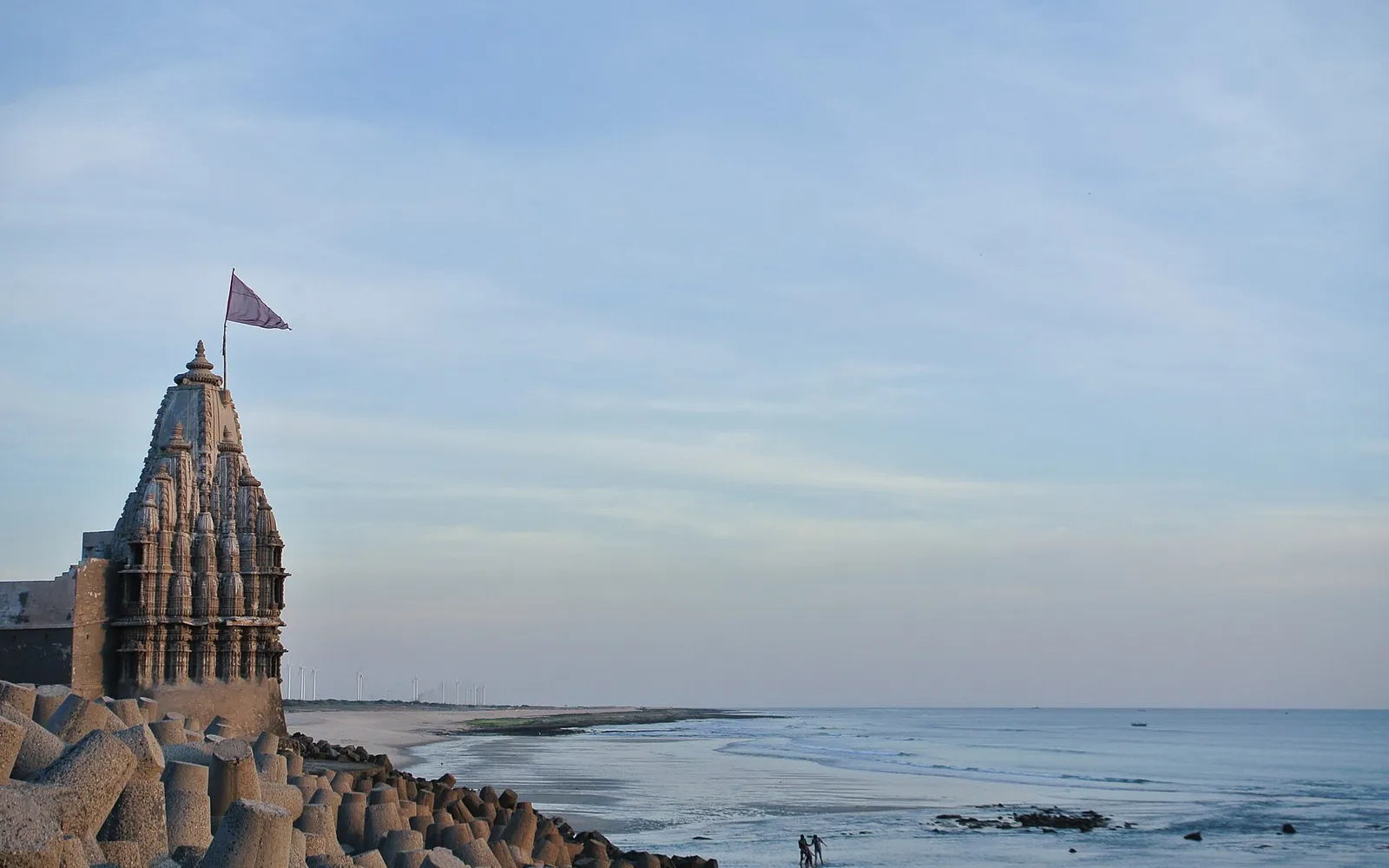
The temple's most striking feature is its position, standing where the land meets the sea, with the sound of the Arabian Sea waves creating a constant and natural backdrop for prayer and meditation. The structure is ancient and built in the traditional Gujarat temple style, featuring a distinctive shikhara that rises above the coastal skyline and can be seen from the waterfront approaches to Gomti Ghat. The stonework of the temple shows the characteristic craftsmanship of Gujarat's sacred architecture, carved motifs, decorative friezes and the solid, enduring construction that has allowed these coastal shrines to withstand centuries of sea wind, monsoon rain and tidal spray. The overall effect is of a temple that feels rooted in the landscape, as though it grew from the rock of the shore itself rather than being built upon it.
The idol of Samudra Narayana within the sanctum depicts Lord Vishnu in his ocean-dwelling form, housed in the garbhagriha (inner sanctum) where the atmosphere is intimate and charged with devotional energy. The proximity to Gomti Ghat makes this temple a natural and seamless part of the pilgrimage circuit that most Dwarka devotees follow, a holy dip at Gomti Ghat, prayers and aarti at the ghat, then a short walk to the Samudra Narayana Temple for darshan, before proceeding on foot to Dwarkadhish Temple for the main darshan of the day. The surrounding area on the waterfront is one of Dwarka's most photogenic and spiritually alive stretches, where the city's ancient sacred life plays out against the constant backdrop of the open sea.
Visiting Samudra Narayana Temple, Timings and Tips
- Morning Darshan 6:00 AM to 12:00 PM
- Evening Darshan 4:00 PM to 8:00 PM
- Best Time to Visit At sunrise (before 7 AM) or at sunset (around 6:30–7:00 PM) when the sea light is most beautiful
- Nearby Gomti Ghat is just steps away, combine both in the same visit
- Dress Code Traditional Indian attire required
- Entry Free for all devotees
How to Reach Samudra Narayana Temple
On Foot from Dwarkadhish Temple
Samudra Narayana Temple is just a 5 to 10 minute walk from Dwarkadhish Temple through the Gomti Ghat area, both are located in the same coastal zone of Dwarka and are comfortably combined in a single waterfront pilgrimage walk. Follow the lanes leading down toward the ghat and the Arabian Sea shore and the temple becomes visible on the waterfront.
From Sudama Setu Bridge
Walk across the Sudama Setu suspension bridge over the Gomti River and the temple is nearby on the shore at the Gomti Ghat waterfront. The bridge approach itself offers fine views of the coastline and provides an atmospheric approach to the Samudra Narayana Temple and Gomti Ghat area.
By Auto-Rickshaw
Any auto-rickshaw from Dwarka city or the railway station can drop you directly at Gomti Ghat, which is the nearest landmark to Samudra Narayana Temple. The fare from Dwarka Railway Station is nominal and the journey takes just a few minutes. Auto-rickshaws are plentiful throughout Dwarka at all hours of the day.
Most Convenient Route
Visit as part of the Gomti Ghat pilgrimage circuit, arrive for the evening aarti at Gomti Ghat and then visit Samudra Narayana Temple immediately afterwards to complete your darshan at this beautiful coastal shrine. This circuit, combined with a subsequent walk to Dwarkadhish Temple for evening darshan, represents the classic Dwarka waterfront pilgrimage that every visitor should experience.
Frequently Asked Questions
Also Explore Dwarka
Gomti Ghat Dwarka
The sacred confluence of Gomti River and the Arabian Sea, take the holy dip and attend the breathtaking evening aarti ceremony that every Dwarka pilgrim should witness.
Gomti Ghat GuideDwarkadhish Temple
The main temple of Dwarka, the eternal abode of Lord Krishna. After your coastal temple visit, complete your darshan at the Char Dham and Jagat Mandir.
Main Temple GuideBhadkeshwar Mahadev Temple
Another stunning coastal temple in Dwarka, the ancient Shiva shrine that sits on a rocky island in the Arabian Sea, accessible by a short bridge.
Visit BhadkeshwarDwarka Darshan Itinerary
Plan the perfect Dwarka pilgrimage, which temples to visit, in what order, and how to cover all sacred sites comfortably in 1, 2 or 3 days.
Plan Your Darshan