Bhadkeshwar Mahadev to Dwarkadhish Temple Distance: The 2 km Return Walk at Sunset
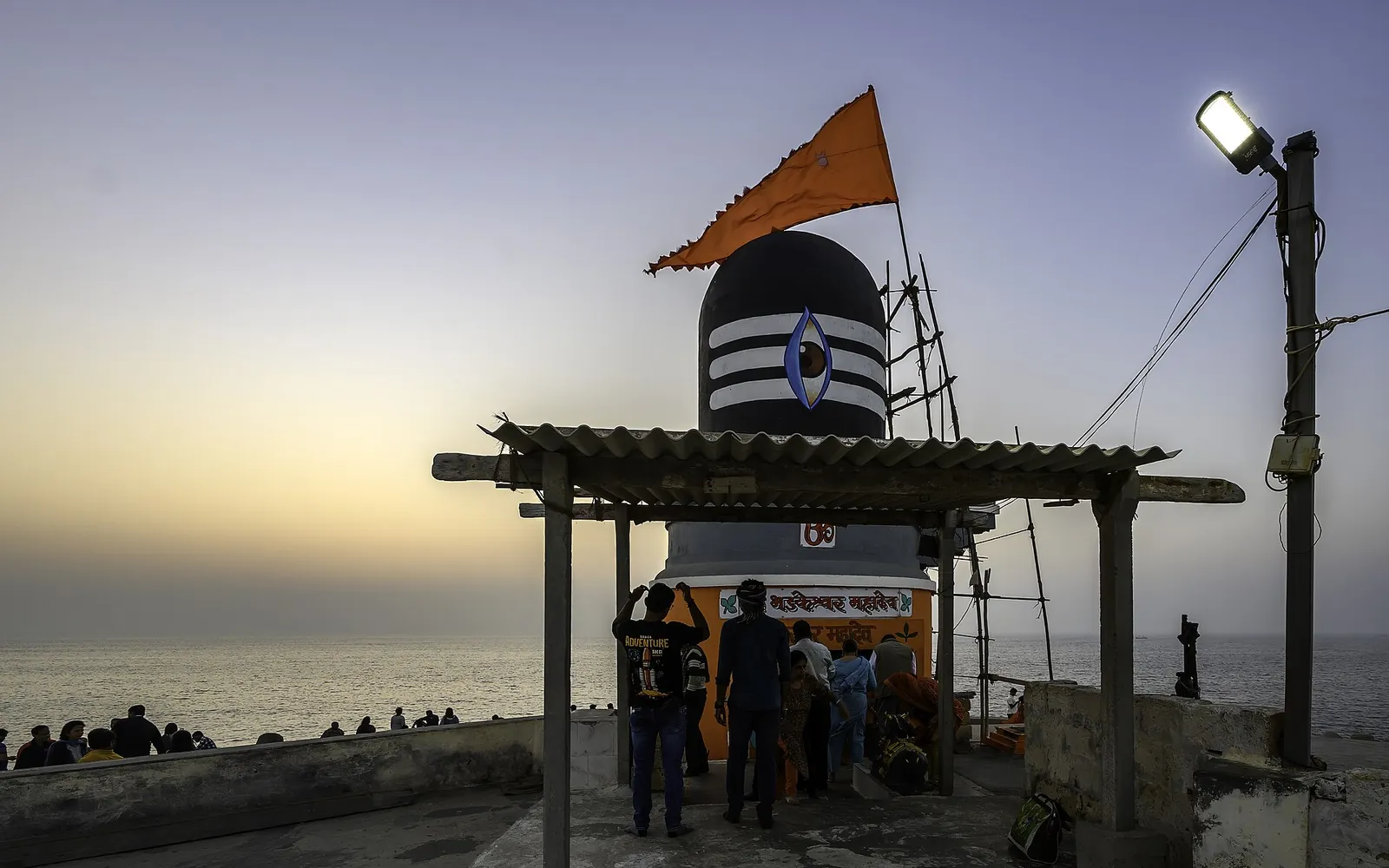
Bhadkeshwar Mahadev to Dwarkadhish Temple is 2 km, a 15-20 minute coastal walk or a 5-minute auto ride for ₹40. Time this return walk for sunset and you will have one of the most quietly spectacular experiences Dwarka offers: the Dwarkadhish shikhara growing ahead of you against a sky turning amber over the Arabian Sea.
The Return Route: From Rock to Shikhara
Your return from Bhadkeshwar Mahadev to Dwarkadhish Temple begins the moment you step back off the temple rock onto the rocky foreshore. The first priority is always the same: clear the rock crossing before the tide turns. If you visited during the low-tide window, you have approximately 2-3 hours of safe access time. Be aware of the time you entered and ensure you are off the rocks with at least 30-45 minutes of margin before the tide begins rising again. Incoming tides on this stretch of the Arabian Sea can move faster than expected, particularly in the transition seasons of September-October and March-April.
Once back on the paved coastal promenade, the return walk to Dwarkadhish is straightforward. The path runs north-east along the seafront, with the sea to your left (west) and the town of Dwarka rising on your right. The most immediately recognizable landmark ahead is the Dwarkadhish Temple shikhara, visible almost immediately once you clear the Bhadkeshwar access area. The shikhara stands at 43 metres and on a clear day it is visible from well beyond the 2 km mark. Walking toward it across the coastal promenade with the sea breeze in your face is the defining image of the Bhadkeshwar-to-temple return.
The coastal path transitions into the more developed Gomti Ghat area at about the 1.5 km mark of the return walk. Here the promenade becomes wider, the Gomti River appears to your right flowing toward the sea, and the stepped ghat structures of Gomti Ghat descend to the water. The Dwarkadhish Temple gate (Swarga Dwar) is a further 500 metres from Gomti Ghat, slightly inland through the bazaar lane. You can choose to end your return at Gomti Ghat for the aarti, or continue to Swarga Dwar for the temple darshan, or do both.
What You See Along the Way
The 2 km coastal walk from Bhadkeshwar back to Dwarkadhish is among the most scenic short distances in Gujarat pilgrimage. To your west (left on the return journey), the Arabian Sea stretches to the horizon. In winter months the sea is calm and a deep blue-green. In the post-monsoon months of September and October the water has a grey-green character and the waves are more energetic. Fishing boats visible in the distance add a human element to the seascape. Occasionally, on the clearest days in winter, you can see the faint outline of Bet Dwarka island far to the north-west.
The rocky coastline itself is interesting to look at from the promenade. The same geological formation that creates the Bhadkeshwar tidal rock continues along the shore, flat sheets of sedimentary rock exposed at low tide, with tide pools that collect shells, small crabs and marine growth. Children and curious visitors stop to look into these pools. The rocks are home to a large population of seabirds, particularly in the early morning hours. Egrets, cormorants and the occasional painted stork use the exposed rocks as feeding grounds during low tide, retreating as the water rises.
To your right (inland), the skyline of Dwarka rises progressively as you walk. The Dwarkadhish shikhara dominates but you will also see the smaller towers of ancillary shrines within the temple complex, and the rooftops of the old dharamshala and merchant houses of the temple town. This combination, sea on one side, sacred city on the other, is what gives the Bhadkeshwar-to-Dwarkadhish walk its particular quality. You are between two worlds: the elemental world of the sea that surrounded the sunken ancient city of Dwarka, and the living spiritual city that arose above it.
Timing the Walk for Sunset and Sandhya Aarti
The Sandhya Aarti (evening worship) at Dwarkadhish Temple occurs at sunset, the exact time varies by season. In winter months (November through February) sunset is around 6:00-6:30 PM. In summer (April through June) it is around 7:00-7:30 PM. The aarti begins as the sun approaches the horizon and lasts 20-30 minutes. To participate in the Sandhya Aarti, you need to be inside the temple complex and in the darshan queue before it starts. Plan to arrive at Swarga Dwar at least 30-45 minutes before sunset.
Working backward: if sunset is at 6:30 PM, aim to arrive at Swarga Dwar by 5:45-6:00 PM. The walk from Bhadkeshwar takes 15-20 minutes, meaning you should leave Bhadkeshwar by 5:25-5:45 PM. Add the time for the rock crossing (10-15 minutes back from the temple to the paved promenade) and you should be ready to leave the Bhadkeshwar temple itself by 5:15-5:30 PM. This means your Bhadkeshwar darshan window on an evening with 6:30 PM sunset should be planned for 4:30-5:00 PM, provided the tide is cooperating at that hour.
Alternatively, if attending the Gomti Ghat Sandhya Aarti rather than the main temple aarti, the timeline is slightly more flexible since Gomti Ghat is only 1.5 km from Bhadkeshwar (5 minutes closer than Swarga Dwar). The Gomti Ghat aarti is conducted outdoors at the water's edge and is visible even if you arrive slightly after it begins. Both aarti experiences are worth attending if you are in Dwarka for more than one evening, the Gomti Ghat aarti has a different character (open air, river-sea confluence, lamps floated on the water) compared to the temple aarti (enclosed courtyard, formal puja, temple bells and conch).
Auto Option for the Return Journey
If you are short on time, need to move quickly to make the aarti, or simply prefer not to walk, autos are available from the coastal road near Bhadkeshwar. Walk from the rocky foreshore up to the road (about 100-150 metres) and autos pass regularly on this road, flag one down and ask for "Dwarkadhish Mandir, Swarga Dwar." The fare is approximately ₹40 for the vehicle. The road route is slightly longer than the coastal walking path (the road curves inland before returning toward the temple) but the 5-minute auto ride will have you at Swarga Dwar far faster than the 15-20 minute walk.
The auto is particularly practical in two situations: when you realize the tide is beginning to come in earlier than expected and you need to get back quickly without lingering on the promenade, or when the sun has already set and the coastal path is losing light. In either case, reaching the road first and then taking an auto is the safest and fastest return. Autos near Bhadkeshwar may be fewer in number than near the main temple, if none are visible immediately, walk toward the town a few hundred metres and you will find them near the small chai stalls along the road.
For pilgrims with mobility considerations, the auto is the clear choice for the return in any case. The coastal promenade is flat and paved but the initial section near Bhadkeshwar where it transitions to rocky foreshore requires careful footing. Once back on the promenade proper the walking is easy, but the combination of tired legs after a full day of temple visits and uneven coastal path makes the auto a practical and inexpensive comfort for the return leg.
Practical Tips for the Coastal Path
Footwear matters on the coastal walk. The paved promenade section is fine with any footwear but the rocky foreshore near Bhadkeshwar requires grip. Rubber-soled sandals or sports sandals are better than smooth leather slippers. Since you remove your footwear at the temple entrance anyway, carrying a small bag for your sandals or tucking them under your arm for the rock crossing is practical. Do not leave footwear on the rocks, a sudden wave or rising tide can claim them.
Carry water, especially in summer months. The coastal walk has no shade and the combination of sea breeze and actual air temperature can be deceptive, the breeze makes it feel cooler than it is while the sun continues to affect you. A 500 ml water bottle is adequate for a 2 km walk but if you are making the full Bhadkeshwar-Gomti Ghat loop, carry a litre. Chai and coconut water vendors appear near Gomti Ghat and near the temple bazaar but not along the promenade itself.
Mobile phone photography on this walk is rewarding but keep your phone secured. The combination of sea breeze, uneven surfaces and the distraction of looking at the landscape creates conditions where dropped phones are more common than elsewhere. A secure pocket or a strap for your phone is sensible. Photography of the Dwarkadhish shikhara from various points along the promenade, particularly with the sea in the foreground, is one of the classic Dwarka image compositions that almost every visitor tries. The light at golden hour (30-60 minutes before sunset) is especially good for this.
Frequently Asked Questions
Also Read
Dwarkadhish to ISKCON
Dwarkadhish Temple to ISKCON Dwarka is 3 km, 10 minutes by auto at ₹60-80 or a 35-minute walk.
Read Full GuideGomti Ghat to Bhadkeshwar
Gomti Ghat to Bhadkeshwar Mahadev is 1.5 km, a 15-minute coastal walk along the Arabian Sea or 5 minutes by auto at ₹40.
Read Full GuideTemple Prasad
Dwarkadhish Temple prasad: Panchamrit free during aarti, Peda sweets ₹30-100, Prasad thali ₹50-100.
Read Full GuideBhadkeshwar Mahadev Temple
Everything about Dwarka's tidal sea temple, significance, tide-based access planning, what darshan is like and the best visiting strategy.
Read MoreGomti Ghat Dwarka
The Sandhya Aarti at the sacred Gomti-sea confluence, what happens at the ghat at sunset and how to experience it fully.
Explore GhatTemple Timings
Complete Dwarkadhish Temple darshan schedule, Mangla at 6 AM through Shayan at 9 PM, with aarti timings by season.
View Timings