Dwarka in Monsoon: What the Temple Guides Will Not Always Tell You
The honest answer: Dwarkadhish Temple is open through every day of the monsoon and the darshan queue is shorter than at any other time of year. But Bhadkeshwar Mahadev may be completely inaccessible, the Bet Dwarka ferry gets cancelled on rough sea days, and the coastal roads can flood briefly after heavy rain. Monsoon Dwarka is real Dwarka, the question is whether the trade-offs match your pilgrimage priorities.
Month-by-Month: What the Monsoon Actually Looks Like
The monsoon in Dwarka is not a uniform four-month wall of rain. It builds and recedes in a pattern that has practical implications for pilgrimage planning. Understanding the month-by-month progression helps you decide which window within the monsoon season is most suited to your visit.
| Month | Weather | Pilgrimage Conditions |
|---|---|---|
| June | 28-38°C, monsoon begins mid-month | Good until mid-June, then increasingly disrupted |
| July | 26-33°C, heavy sustained rain | Dwarkadhish open; Bhadkeshwar often closed; ferry unpredictable |
| August | 26-33°C, heaviest month; Janmashtami | Most disrupted month EXCEPT Janmashtami which draws massive crowds |
| September | 28-35°C, rain tapering after mid-month | Improving rapidly by late Sep; Navratri begins Oct 2 |
June is actually split in two characters. The first two weeks of June, before the monsoon arrives from the Arabian Sea, are hot (up to 38°C) but essentially dry. Darshan conditions are like a hot summer day rather than a monsoon experience. The second half of June marks the monsoon onset, and from there through August, conditions change daily based on rain intensity and sea state.
September is the most underrated monsoon-window option. By mid-September the rain frequency drops significantly, the temperature is 28-35°C, and the landscape around Dwarka, the coastal scrubland and the approaches to the ghats, is washed green. The crowds are still at their lowest, and the conditions for darshan are close to what you get in November. Many pilgrims who cannot travel in October or November find that mid-to-late September is an excellent compromise.
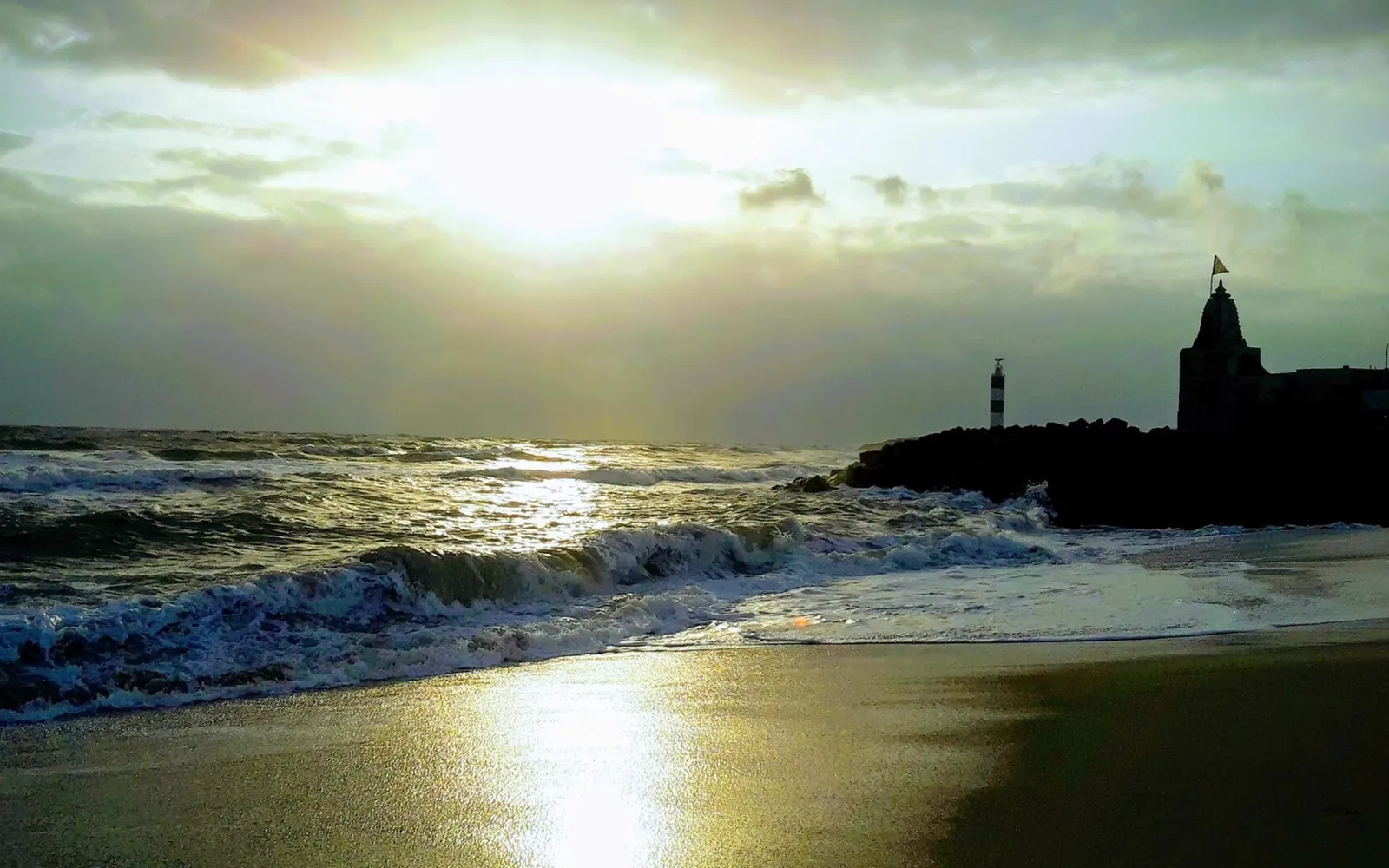
Dwarkadhish Temple in Monsoon: The Full Truth
The Dwarkadhish Temple has maintained its daily puja and aarti schedule through monsoon seasons for centuries. The temple structure, built in the Chalukya architectural style, sitting on a raised platform, manages rain effectively. The main sanctum, corridors, and approach stairs drain efficiently. On normal monsoon days, even heavy rain does not interrupt the aarti schedule.
The queue in monsoon is genuinely shorter. On a July or August weekday that is not a festival or holiday, the Dwarkadhish darshan queue can be as short as 20-40 minutes in the general line. For pilgrims whose primary purpose is the darshan itself, the moment of standing before the four-armed Lord Dwarkadhish, the monsoon weekday offers the most unimpeded access of the entire year. Dwarkadhish Temple has no official paid "VIP darshan" scheme at any time of year, every pilgrim uses the same free general queue, so on a quiet monsoon weekday there is nothing to buy and nothing you are missing by not buying it.
The experience of the Sandhya Aarti at the temple during a light monsoon rain is described by devotees who have attended it as particularly moving, the lamps burning against the grey light, the sound of rain on stone mixing with bells and conch, the temple shikhara disappearing into low cloud. This is not a lesser experience than the winter aarti; it is a different one, with its own specific character that some find more devotionally intense.
What Is Inaccessible During Monsoon
This is the part that is not always clearly communicated. Three sites in the Dwarka pilgrimage circuit have monsoon-specific access problems:
Nageshwar Jyotirlinga, 17 km from Dwarka, is fully accessible in monsoon. The temple is open 5 AM to 9 PM year-round, and the road from Dwarka to Nageshwar does not flood under normal monsoon conditions. The drive through the flat coastal plain in July-August, when the landscape turns green after months of dry scrub, is one of the better driving experiences in the region.
Janmashtami in Dwarka: The Monsoon Exception
Janmashtami, Lord Krishna's birth celebration, falls on Ashtami of the Krishna Paksha of Bhadrapada month. In 2026 this falls approximately on September 4-5. For this festival alone, the monsoon conditions do not deter pilgrims. Dwarka sees its largest single-day or two-day crowd of the entire year during Janmashtami, surpassing even the January peak season.
The significance is straightforward: Dwarka is where Krishna ruled as king, where the Dwarkadhish Temple stands on the site of his legendary palace. Celebrating his birth here carries a meaning that Mathura and Vrindavan, his childhood cities, cannot replicate. The midnight ceremony at Dwarkadhish Temple, when the precise moment of Krishna's birth is observed, draws devotees who have travelled days to be present. Rain does not factor into the decision.
Practically, Janmashtami Dwarka requires planning months ahead. Accommodation within walking distance of the temple is booked by April-May for the August festival. Train tickets on the routes approaching Dwarka in the days before Janmashtami sell out fast. If you want to attend Janmashtami at Dwarkadhish, the logistics require the same advance planning as a January peak week, book accommodation first, then plan transport. The darshan queue on Janmashtami night is the longest of the year. There is no official VIP darshan pass to shorten it, Dwarkadhish runs no paid priority scheme even on its busiest night, so every pilgrim joins the same general queue, and a wait of several hours is normal; plan your night with that in mind and ignore anyone offering a paid "VIP" shortcut near the temple.
The Honest Recommendation: Who Should Visit in Monsoon
Monsoon Dwarka suits pilgrims who want Dwarkadhish darshan specifically, are flexible about Bhadkeshwar and Bet Dwarka, and prefer very low crowds and lower prices. It does not suit those who want the complete Dwarka circuit including all tidal and ferry-dependent sites, or those who require predictable daily weather for a fixed itinerary.
For devotees who have already done the complete Dwarka circuit in a prior visit and are returning specifically for Dwarkadhish darshan and Gomti Ghat, a quiet monsoon weekday in July or early August (avoiding the Janmashtami period unless specifically attending it) offers the most intimate temple experience of the year. The absence of tour groups and peak-season crowds creates a very different quality of time at the temple, slower, quieter, more personally devotional.
The accommodation price advantage in monsoon is significant, rates can be 40-60% below December peak rates. For budget pilgrims, this makes a monsoon visit economically very accessible. The Trust Bhojnalaya continues to provide meals through monsoon, making the complete cost of a simple monsoon Dwarka visit very modest.
Frequently Asked Questions
Also Read
From Vadodara
Vadodara to Dwarka is approx 550-570 km by road (8-10 hrs) or ~10 hrs by train.
Read Full GuideDwarka with Family
Dwarka with family means planning for children's energy and elders' comfort, temple queue management, rest stops, and which temples to skip if time-pressed.
Read Full GuideJanmashtami in Dwarka
The biggest festival in Dwarka, what happens at Dwarkadhish Temple on Krishna's birthday, how to plan, and why the midnight ceremony is unmissable.
Read MoreBhadkeshwar Mahadev Temple
The tidal island temple of Lord Shiva, tide schedule, how to reach it, and what monsoon conditions mean for access.
Read MoreBest Time to Visit Dwarka
Full month-by-month breakdown of weather, crowd levels, and festivals to choose the right date for your pilgrimage.
Read More