Gopi Chandan: The Sacred Clay of Dwarka Every Vaishnava Devotee Knows
Gopi Chandan is the pale, whitish-yellow clay traditionally sourced from the Dwarka region of Gujarat and used across the Vaishnava world, including the Gaudiya and ISKCON traditions, to apply the sacred tilak worn each day as a mark of devotion to Krishna. Small and unassuming as a physical object, it carries an enormous weight of devotional meaning, rooted in one of the most tender legends connected to Krishna's Dwarka.
What Gopi Chandan Is, and the Devotional Legend Behind It
Gopi Chandan is a fine, pale clay, usually a golden-yellow, sometimes appearing in slightly darker shades depending on where along the source region it is dug, that Vaishnava devotees use to prepare tilak, the paste markings applied to the forehead and body as an outward sign of surrender to Vishnu and Krishna. The name itself is telling. "Chandan" ordinarily refers to sandalwood paste, the substance most commonly used across Hindu traditions for tilak and for cooling, fragrant application to the skin. By calling this clay "Gopi Chandan", the chandan of the Gopis, tradition is making a direct claim: that this particular clay performs the same devotional function as sandalwood paste, but carries a sanctity that ordinary sandalwood does not, because of what it is believed to actually be.
That belief rests on one of the most moving stories connected to Krishna's later life in Dwarka. The Gopis of Vrindavan, the cowherd milkmaids among whom Krishna spent his childhood and youth, are held up throughout the Bhagavata Purana and the wider Vaishnava devotional tradition as the supreme exemplars of prema, pure unconditional loving devotion, unclouded by any worldly motive. Their love for Krishna was not romantic longing in an ordinary sense but was read by generations of Vaishnava theologians as the highest possible model of the soul's relationship with the divine, a devotion so complete that separation from Krishna was, for them, unbearable in a way no other kind of loss could be.
When Krishna left the pastures of Vrindavan for Mathura and finally settled as king of the great coastal city of Dwaraka, the Gopis were left behind, their devotion undiminished by distance or by Krishna's transformed circumstances as a monarch. Tradition holds that the Gopis eventually made their way toward Dwaraka in their longing to be near him again, but on reaching the region they entered a state of profound meditative absorption, samadhi, so deep and so total that their very bodies are believed to have dissolved into the earth of that landscape. Rather than reading this as an end, Vaishnava tradition reads it as a transformation: the Gopis chose, in effect, to remain permanently and physically close to Krishna by becoming one with the sacred soil of the region he had made his home. The clay that resulted from this merging, pale, luminous, unlike ordinary earth, came to be regarded as sanctified in a category of its own, and it is this clay that devotees know as Gopi Chandan.
This is why Gopi Chandan is treated so differently from any other clay or mineral pigment used for religious markings elsewhere in India. It is not valued for a chemical property or a particular pleasing colour. Its entire spiritual authority rests on the belief that it is, quite literally, the physical remainder of the purest devotion Krishna's own life produced, which is also why devotees consider it especially meaningful to obtain the clay from as close to its traditional source as possible, rather than from an anonymous supplier with no connection to Dwarka at all.
Where the Clay Actually Comes From: Gopi Talav and the Gomti Riverbed
Set apart from the legend, Gopi Chandan also has a concrete physical geography. The clay is traditionally dug from the Dwarka region of Gujarat, and two locations in particular are named again and again as its authentic source. The first and most important is Gopi Talav, a lake roughly 20 kilometres from Dwarka city whose yellow-tinged water and soil are directly identified in local tradition as the site where the Gopis' samadhi is believed to have occurred. Readers who want the fuller history and visiting details of the lake itself, its temple, its legend in more depth, and how to combine a visit with nearby Nageshwar Jyotirlinga, should see our dedicated Gopi Talav guide; this page is concerned specifically with the clay and its use as tilak rather than with the lake as a pilgrimage site in its own right.
The second source region is the bed and banks of the Gomti river as it passes through Dwarka before meeting the sea. The Gomti is itself considered a sacred river within the Dwarka pilgrimage landscape, and devotees and local vendors have long collected clay from its banks and shallows as a second, complementary source of Gopi Chandan alongside Gopi Talav. Some devotional literature draws a rough distinction between clay associated with the Gomti riverbed and clay from the Gopi Talav area, though in practice, once the clay has been dried, shaped and sold as small blocks in the Dwarka market, most pilgrims do not attempt to distinguish precisely which patch of ground a given piece was dug from, the entire Dwarka region carries the same sanctity in this respect.
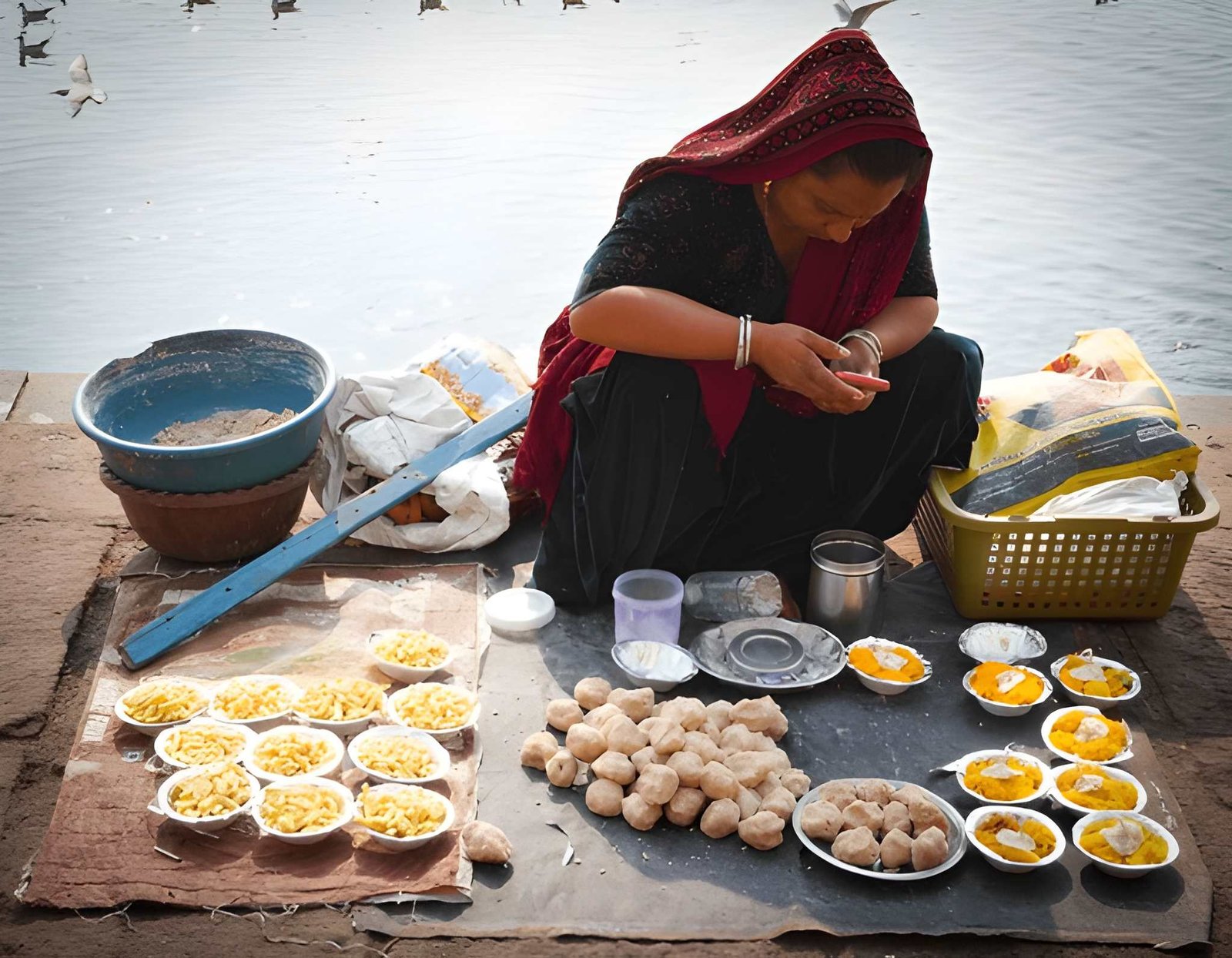
The Gomti riverbed near Dwarka, pictured above, is one of the two traditional source areas from which Gopi Chandan clay has historically been gathered, alongside the Gopi Talav lake bed further from the city. Pilgrims performing Gomti Ghat rituals will often see small quantities of the pale clay visible along the bank here, though most devotees obtain their tilak clay already dried and shaped from vendors rather than collecting it themselves at the riverside.
Physically, the clay is fine-grained and soft, and dries to a pale, almost chalky block that can be easily broken into smaller pieces. Colour varies slightly by batch and by exactly where along the source region it was dug, some pieces are close to white, others a soft pale yellow, and devotional retailers occasionally describe darker variants as well, though the whitish to pale-yellow range is what is most commonly sold and used around Dwarka itself.
How Gopi Chandan Is Used: The Twelve-Tilak Practice
For practicing Vaishnavas, applying tilak is a daily discipline rather than an occasional ritual gesture. After bathing, a small piece of Gopi Chandan is moistened with water and rubbed against a flat stone or plate until it forms a smooth, workable paste. This paste is then applied, traditionally with the ring finger, in the distinctive Urdhva Pundra pattern, two vertical lines rising from the bridge of the nose toward the hairline, with a gap between them, often with a small central line representing Lakshmi. Beyond the forehead, the fuller devotional practice extends the tilak to twelve parts of the body altogether: the forehead, chest, throat, stomach, both upper arms, both forearms, the neck, both sides of the ribs, and the upper back, with each application traditionally accompanied by the recitation of one of the twelve principal names of Vishnu.
Devotees describe this twelve-part application as a way of consecrating the entire body, point by point, rather than simply marking the forehead as a social or sectarian identifier. The physical marks are understood to serve a double purpose: outwardly, the tilak identifies the wearer as a devotee within the Vaishnava community; inwardly, the practice is treated as a discipline that helps keep the mind anchored on Krishna throughout the day, with the sensation of the paste on the skin serving as a recurring, embodied reminder of one's spiritual intention. Because Gopi Chandan is believed to carry the sanctified presence of the Gopis' own devotion, applying it is regarded by many practitioners as more spiritually potent than applying tilak made from an ordinary source of clay or sandalwood, though sandalwood remains an entirely acceptable and widely used alternative within the broader Vaishnava world.
Within the Gaudiya Vaishnava tradition in particular, the lineage that gave rise to the modern ISKCON movement, Gopi Chandan tilak is closely associated with the daily sadhana of practicing devotees, applied fresh each morning as part of the same routine that includes bathing and chanting. Blocks of the clay are typically small enough to last a single devotee many weeks of daily use, since only a small amount is needed for each application.
Obtaining Genuine Gopi Chandan While Visiting Dwarka
For pilgrims visiting Dwarka, obtaining Gopi Chandan directly from the region it is traditionally associated with is considered a meaningful part of the visit, and it is neither expensive nor difficult to find. Small vendors set up near the Gopi Talav area, roughly 20 kilometres outside Dwarka city, sell dried blocks and smaller pieces of the clay to the pilgrims who make the trip out to the lake, this is generally regarded as the most direct and authentic source, since it comes from the exact site associated with the Gopis' legend. Within Dwarka town itself, the market lanes around Dwarkadhish Temple and other religious goods stalls across the city routinely stock Gopi Chandan alongside other everyday puja items such as incense, tulsi beads and prasad packets, making it easy to pick up a piece even for pilgrims who are not specifically travelling out to Gopi Talav.
Prices are modest and consistent across most sellers, a single piece or small block typically costs somewhere in the range of ₹10 to ₹50, depending on size and where it is sold. There is generally no need to bargain hard or worry about being overcharged for an item of this nature; the low price reflects both the abundance of the raw material and the fact that it is treated as a devotional item rather than a commercial product. When selecting a piece, look for clay that is dry, reasonably firm, and pale in colour (white to soft yellow) rather than gritty or mixed with visible impurities, as this generally indicates a cleaner, better-prepared piece suited for use as tilak. Vendors near Gopi Talav and in the Dwarka market are generally straightforward about what they are selling and where it has come from, and asking a simple question about the clay's source is a normal and welcome part of the interaction.
Devotees who cannot travel to Dwarka in person are not without options: ISKCON centres and other Vaishnava religious goods suppliers around the world stock prepared Gopi Chandan for their congregations, sourced through established supply chains back to the Dwarka region. For a pilgrim actually standing in Dwarka, however, carrying home a small piece purchased at or near Gopi Talav itself remains the most direct way to bring back a tangible, sanctified connection to the city and to the legend of the Gopis that gives the clay its meaning.
Frequently Asked Questions
Also Read
Gopi Talav Dwarka Guide
The full story of Gopi Talav, the sacred lake near Dwarka where tradition holds the Gopis merged into the earth, plus how to visit and what to see there.
Read Gopi Talav GuideKrishna and Dwarka
How Krishna came to establish his kingdom on the Gujarat coast, and how that story connects to the sacred sites pilgrims visit across Dwarka today.
Read Krishna's StoryDwarka History
The layered history of Dwarka, from its ancient origins and submergence legends to its standing today as one of the Char Dham and Sapta Puri cities.
Read Dwarka's History