Lord Krishna and Dwarka: The City He Built, Ruled and Left Behind to the Sea
Krishna moved from Mathura to Dwarka to save his people from Jarasandha's relentless attacks. Vishwakarma built the golden city on land reclaimed from the sea. Krishna ruled here for over a century, and when he left the world, the sea took the city back.
What is the connection between Lord Krishna and Dwarka?
Krishna moved from Mathura to Dwarka to protect his people. Vishwakarma built the city on reclaimed land. Krishna ruled here for over 100 years before the city was submerged by the sea.
Useful References
Why Krishna Left Mathura: The Jarasandha Problem
Lord Krishna was born in Mathura, in the prison of Kamsa. After killing Kamsa and liberating Mathura, Krishna was expected to rule the Yadava clan from there. But the death of Kamsa created a new and more dangerous problem: Jarasandha, the powerful king of Magadha (modern-day Bihar), was Kamsa's father-in-law. Kamsa had married two of Jarasandha's daughters, Asti and Prapti, and Jarasandha's grief and fury at Kamsa's killing was immense.
Jarasandha attacked Mathura with enormous armies. He attacked 17 times. Each time, Krishna and Balarama and the Yadava warriors repelled him, but at enormous cost to life and resources. Mathura was not built for this kind of prolonged siege warfare. The people lived in fear, agriculture was disrupted, and the Yadavas were slowly being worn down. Jarasandha also formed alliances with other kings, and a coalition was building against the Yadavas that would eventually overwhelm them if they stayed in their land-locked city.
Krishna's decision to relocate was not a retreat, it was a strategic act of statecraft that prioritised his people's survival over his own honour. He could have fought to the last, as warrior culture might demand. Instead, he chose to move the entire Yadava community to a new, more defensible location on the coast, where the sea would protect them on one side and they could build a prosperous, secure kingdom. This decision is why he is called Ranchhor, "one who leaves the battlefield", a title that in Dwarka carries not shame but wisdom. The famous Ranchhodraiji Temple in Dakor, Gujarat, honours this aspect of Krishna's character.
Vishwakarma Builds Dwarka: A City Risen from the Sea
Having decided to move, Krishna did not simply find an empty coastal site and build a city. According to the Puranic accounts, he asked Samudra, the ocean god, to give up land from the sea. Samudra granted the request and receded, revealing 12 yojanas (a traditional unit, roughly 96 miles in some interpretations, though scholars debate the exact measurement) of land that had previously been underwater. This reclaimed coastal land became the foundation of Dwarka.
Krishna then summoned Vishwakarma, the celestial architect who designs the homes of the gods and constructs divine weapons. Vishwakarma is to Hindu mythology what Hephaestus is to Greek, the master craftsman of the heavens. He built the city of Dwarka in a single night. The Puranas describe it in lavish terms: a city of golden walls and jeweled towers, with broad streets and elegant mansions, with gardens and pavilions and a harbour on the coast. The Gomti River flowed through it and met the sea at what is now Gomti Ghat. The innermost palace, where Krishna lived, stood at the site of the current Dwarkadhish Temple.
The physical reality of building an entire city overnight is understood by devotees as expressing the divine nature of the construction, Vishwakarma does not work at human speed with human materials. Whether read literally or allegorically, the story establishes that Dwarka was not a gradually grown settlement but a deliberately planned, divinely ordered city built to a specific purpose: to house the Yadava people in dignity and security, with their lord Krishna as its king.
Krishna's Rule in Dwarka: Dwarkadhish, King of the West
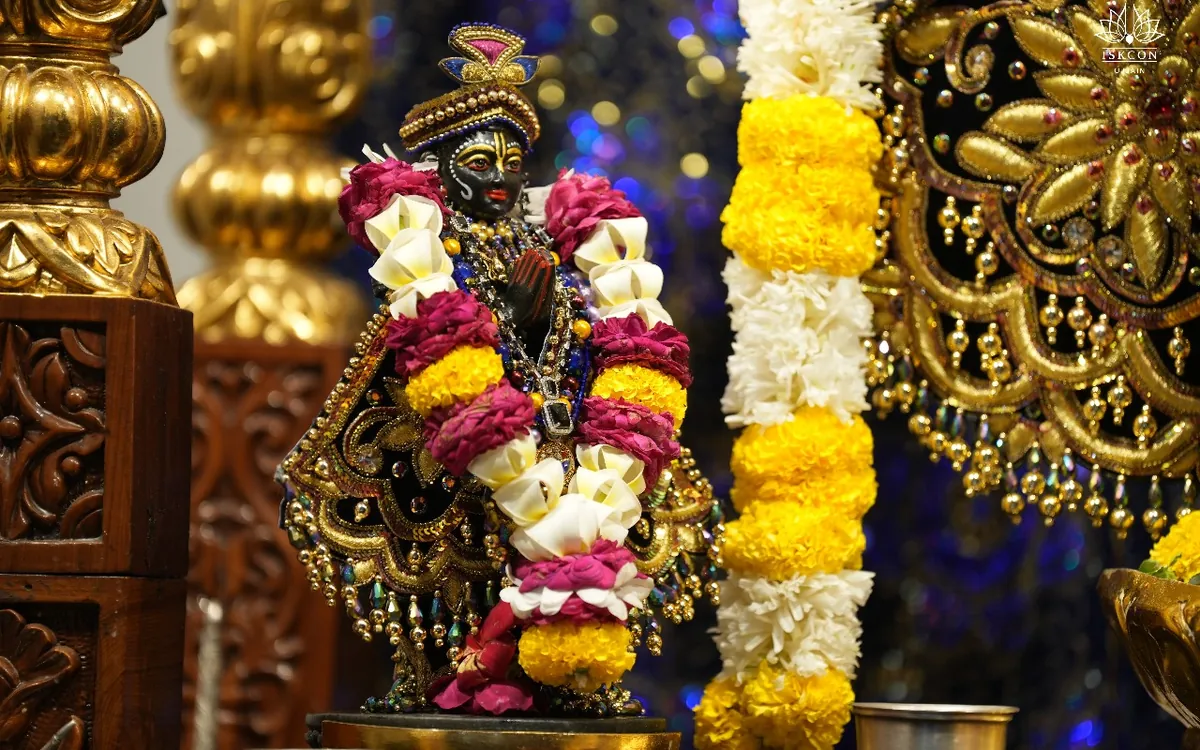
In Dwarka, Krishna was no longer simply a cowherd boy of Vrindavan or even the prince who killed Kamsa. He was Dwarkadhish, the king, the lord, the ruler of a prosperous maritime kingdom. The title Dwarkadhish means "King of Dwarka" (Dwarka + adhish = master/king), and it is the title by which the deity in the main temple is worshipped to this day. The form of Krishna worshipped at the Dwarkadhish Temple is Krishna as king, depicted with four arms, holding the conch, the discus, the mace, and the lotus, robed in royal garments and crowned.
From Dwarka, Krishna coordinated many of the events of the Mahabharata period. He travelled to Hastinapura as a peace ambassador for the Pandavas before the Kurukshetra war. He served as Arjuna's charioteer on the battlefield, and it was on that chariot, between the two armies, that he delivered the Bhagavad Gita. After the war, he returned to Dwarka. The Yadava clan held court here, and the city became a seat of culture, learning, and religious practice. The great sage Narada is said to have visited and marvelled at the city's prosperity.
Krishna's time in Dwarka also includes some of the most beloved stories of his personal life. His 16,108 wives, beginning with Rukmini, whom he married first and whose temple stands 2.5 km from the main shrine, lived in Dwarka. The island of Bet Dwarka (36 km away, now reached by ferry from Okha) is traditionally identified as Krishna's personal residence, his favourite retreat away from the royal city, where he spent time with Rukmini and the other consorts in a more intimate setting. This is why Bet Dwarka carries such deep significance for Vaishnava pilgrims.
The End of Dwarka: Submersion Foretold and Fulfilled
The ending of Dwarka is one of the most dramatic passages in all of Hindu scripture. The Mausala Parva (Club War section) of the Mahabharata describes how the Yadava clan, despite their prosperity and power, destroyed themselves in a drunken civil war among their own ranks. A curse by the sage Gandhari (who had lost her sons at Kurukshetra) had been working its way through the Yadava lineage, and on a beach near Prabhasa (near modern Somnath), the Yadavas fought and killed each other with clubs made from the reeds growing on the beach.
Krishna himself survived this fratricidal carnage. He wandered into a forest, sat in meditation, and was struck by an arrow from a hunter named Jara who mistook his foot, resting in the grass, for the ear of a deer. This is understood in the tradition as the moment Krishna chose to depart the world, the arrow of Jara (whose name means "old age") ended his earthly existence. Before departing, Krishna had already told Arjuna that the sea would claim Dwarka after he left, and that Arjuna should escort the surviving women and children to safety.
Within seven days of Krishna's death, the Arabian Sea rose and submerged the city of Dwarka, exactly as foretold. The Mahabharata's account is matter-of-fact: the sea simply came and covered the city, leaving nothing visible above the waterline. Arjuna, who arrived to escort the survivors, watched the golden city disappear beneath the waves. Only one spot, the innermost sanctum of Krishna's palace, is said to have remained, preserved for future worship. That spot is where Dwarkadhish Temple stands today.
What the Archaeologists Found: Underwater Dwarka
The question of whether the mythological Dwarka corresponds to an actual submerged city has been investigated seriously by Indian archaeologists. The Marine Archaeology Unit of the National Institute of Oceanography (NIO) conducted extensive underwater surveys and excavations off the coast of present-day Dwarka between 1983 and 2007, led by archaeologist S.R. Rao.
The findings were significant. Divers and underwater equipment discovered submerged stone walls, stone anchors, pillars, triangular stones with holes (possibly used for mooring), pottery sherds, and other structural remains in the sea close to Dwarka's modern coastline. Some of these finds were radiocarbon dated to different ancient periods. The stone anchors, in particular, suggest a functioning harbour existed at this location in antiquity. The structural remains indicate occupation of this coastal area over a very long period.
What the archaeological evidence does not do, and cannot definitively do, is confirm the mythological narrative in all its details. The structures found are real, and they are ancient, and they were at some point submerged. Whether they are the remains of the same city described in the Mahabharata as Krishna's Dwarka is a question that mixes religious faith with archaeological interpretation. For millions of devotees, the question is already answered by faith. For archaeologists, the finds are genuine and important evidence of ancient coastal habitation and trade at Dwarka, evidence that an ancient city here was indeed swallowed by the sea.
What Remains of Krishna's Dwarka Today
The physical golden city described in the Puranas is gone, taken by the sea as Krishna foretold. But what remains is a remarkable accumulation of sacred sites, living traditions, and physical connections to the story. The Dwarkadhish Temple (Jagat Mandir) stands at the believed site of Krishna's innermost palace. The idol worshipped here, Dwarkadhish in his royal four-armed form, has been venerated continuously for over 2,500 years in one form or another.
Bet Dwarka (Beyt Dwarka), the island 36 km from present-day Dwarka accessed by ferry from Okha, is identified in tradition as Krishna's personal residential island, his private retreat from the responsibilities of kingship. The temple at Bet Dwarka is considered by many devotees to be the most intimate of all the Dwarka shrines because it marks where Krishna actually lived, as opposed to where he held court. The main Dwarkadhish Temple at Dwarka town is the public throne room; Bet Dwarka is the home.
Gomti Ghat and the Gomti River, the tidal channel that flows past the temple, mark the boundary river that the Puranas say separated the built city from the sea. The Sudama Setu pedestrian bridge, the Rukmini Devi Temple where Krishna's first wife is worshipped separately, the Bhadkeshwar Mahadev Temple on its tidal island, all of these form the landscape of a living city that carries the imprint of Krishna's presence not just in stone but in the daily rhythm of aartis, rituals, and pilgrimage that has continued here without break for millennia.
Frequently Asked Questions
Also Read
Dwarka History
The full documented history of Dwarka, from Krishna's era through the Adi Shankaracharya period, medieval raids, and modern archaeological findings.
Read MoreBet Dwarka
Krishna's personal island residence, how to reach Bet Dwarka by ferry from Okha, timings, darshan, and what makes this island special.
Read MoreWhy Dwarka Is Char Dham
How Adi Shankaracharya's 8th-century decision made Dwarka the western pillar of the Char Dham circuit and why Krishna's city was the only possible choice.
Read MoreBhalka Tirth
Where Lord Krishna's earthly journey ended, the legend of the hunter's arrow and the site near Somnath that closes the Dwarka story.
Read MoreGopi Chandan Dwarka
The sacred clay from Dwarka's Gopi Talav region used for Vaishnava tilak, its devotional legend and where pilgrims can find it.
Read More