Swarg Dwar and Moksha Dwar: The Two Gates of Dwarkadhish Temple
Every pilgrim who takes darshan at Dwarkadhish Temple passes through two named gates, not one. Swarg Dwar, the Gate to Heaven, is where the journey into the temple begins, reached by climbing 56 stone steps up from the Gomti riverside. Moksha Dwar, the Gate of Liberation, is where the journey ends, on the opposite, town-facing side of the temple. The two names are not decorative. They describe, in the plainest possible language, what the temple believes happens to a devotee between entering and leaving: a passage from an ordinary, burdened state toward something closer to release.
Useful References
Swarg Dwar: The Gate to Heaven and the 56 Steps
Swarg Dwar sits on the northern face of Dwarkadhish Temple, directly facing the Gomti river where it meets the Arabian Sea. This is the gate through which every pilgrim enters the temple for regular darshan, there is no alternate entrance for the general devotee. Before you reach the gate itself, you climb a flight of 56 stone steps rising from the riverside ghat up to the temple's raised plinth. The steps are not incidental to the experience; in Dwarka's devotional culture, they are treated as part of the ritual itself.
The number 56 is widely held by pilgrims and local priests to correspond to 56 varieties of sin or impurity that a human being accumulates in ordinary life. The popular understanding is straightforward: as you climb each step, you are symbolically shedding one of these impurities, so that the ascent itself becomes a form of purification. By the time you reach the top step and pass through Swarg Dwar, you are believed to arrive in a cleaner, more receptive state, better prepared for the darshan of Lord Dwarkadhish that follows just beyond the gate. Whether a pilgrim takes this literally or as a devotional metaphor, the physical act of climbing with intent, counting steps, saying the Lord's name with each one, pausing to look back at the river, is a genuinely common practice at Dwarkadhish, and it shapes how many visitors experience their arrival at the temple.
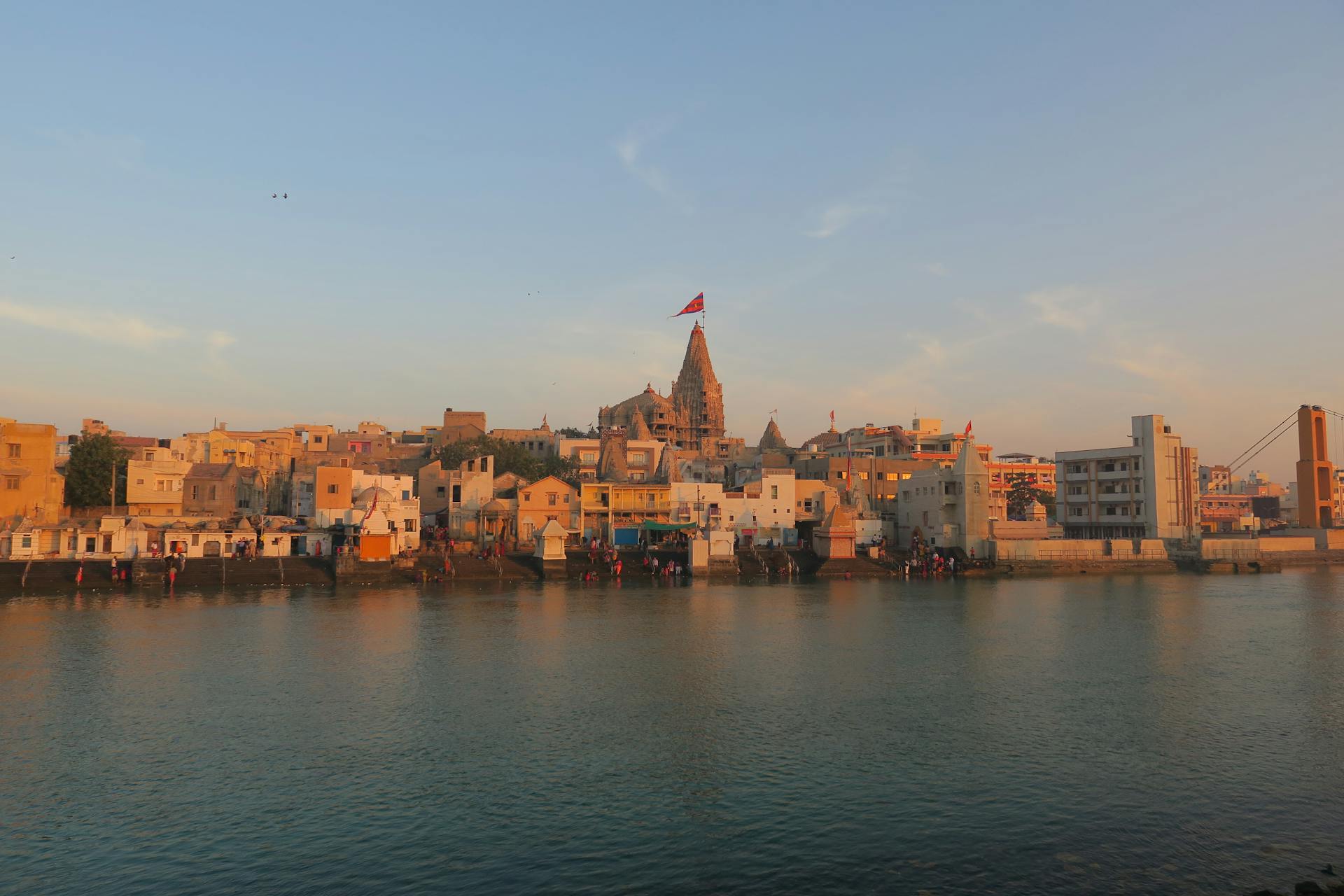
The name itself, Swarg Dwar, translates directly as "Gateway to Heaven." It positions the climb and the gate as the threshold between the ordinary world, the ghats, the boats, the market lanes of Dwarka town, and the sacred interior of the temple. Crossing that threshold is understood as a passage upward, both literally, since you are climbing, and spiritually, since you are moving from the profane world into consecrated space. Architecturally, Swarg Dwar is also the temple's most visually striking gate: elaborately carved stonework rises above the doorway as part of the temple's tall shikhara structure, and it is this gate, rather than Moksha Dwar, that most photographs of the Dwarkadhish skyline actually show, since it is the face of the temple visible from the river and the sea.
Moksha Dwar: The Gate of Liberation
Moksha Dwar is on the opposite side of the temple from Swarg Dwar, facing south, toward the town rather than the river. It functions as the exit only. After completing darshan of Lord Dwarkadhish at the inner sanctum, pilgrims are directed out through Moksha Dwar rather than back the way they came. This is enforced deliberately: Dwarkadhish Temple maintains a strictly one-way flow of devotees, entering through Swarg Dwar and leaving through Moksha Dwar, so that the crowd inside the temple moves in a single direction rather than doubling back on itself. During peak season and major festivals, this one-way rule becomes especially important for crowd management, and temple staff use barricades along the darshan route to keep the flow moving correctly.
The name Moksha Dwar means "Gate of Liberation" or "Gate of Salvation", moksha being the concept, central to Hindu theology, of release from the cycle of birth and death, the final freeing of the soul. Applied to a temple gate, the name makes an explicit theological claim about what darshan is supposed to accomplish: that having entered through the gate to heaven, climbed the steps of purification, and stood before the Lord in the sanctum, a devotee leaves in a changed spiritual condition, not literally attaining moksha in the ultimate sense with a single visit, but participating symbolically in that movement toward liberation each time they complete the darshan cycle.
Practically, Moksha Dwar opens onto the town side of Dwarka, closer to the market lanes and the roads leading toward the bus stand and other parts of the town. Pilgrims who have deposited belongings at a Swarg Dwar locker counter before entering need to remember this, since you exit through a different gate, collecting a bag or phone left at the entrance counter sometimes requires either returning to the Swarg Dwar side or using a designated collection point near Moksha Dwar, depending on which counter you used. It is worth asking the counter staff directly when you deposit an item, so there is no confusion after darshan when you are naturally eager to move on to your next stop, whether that is Gomti Ghat, Rukmini Devi Temple, or a meal in town.
Temple Layout, Lockers and Photography Rules
Dwarkadhish Temple itself, known formally as Jagat Mandir, rises as a five-storey structure supported by 72 carved pillars, its shikhara visible from a considerable distance across the town and the river. Swarg Dwar and Moksha Dwar are the two principal named gates of this structure, but they should be understood as functional openings in a much larger built complex that includes the main sanctum, subsidiary shrines, and connecting mandapas. The gates are named and significant specifically because of the roles they play in the pilgrim's movement through the temple, entry and exit, not because they are architecturally separate buildings.
Cloak room and locker facilities operate near both gates. Mobile phones, cameras, and leather items such as belts, wallets, and bags are not permitted inside the temple and must be deposited before entering. Charges typically run ₹20 to ₹40 per item depending on what is being stored. Because entry happens at Swarg Dwar and exit at Moksha Dwar, it is worth being deliberate about where you deposit belongings, most pilgrims use the Swarg Dwar counter simply because that is where they naturally pass first, but it means planning the collection of those items after you emerge from Moksha Dwar rather than assuming you can walk straight back to the same spot. Photography and videography are prohibited throughout the temple interior and sanctum; this rule is enforced by temple staff at both gates, and phones are one of the primary reasons for the locker requirement in the first place.
Elderly and differently-abled pilgrims should be aware that the standard route to Swarg Dwar involves the 56-step climb, which is not avoidable via that gate. Pilgrims who cannot manage stairs should ask temple staff or local guides about alternate access, Dwarkadhish Temple's management does accommodate visitors who need assistance, and wheelchair or supported access is generally arranged on request rather than being a marked, self-service route. It is far better to ask at the temple office or with staff near the entrance before joining the general queue than to discover the difficulty partway up the steps, particularly during the crowded morning and evening aarti windows when the staircase and both gate areas are at their busiest.
Reading the Gates as a Pilgrim: Heaven In, Liberation Out
Taken together, Swarg Dwar and Moksha Dwar frame the entire Dwarkadhish darshan as a single symbolic arc rather than a simple visit to a shrine. You arrive at the riverside as an ordinary person, carrying the accumulated weight of everyday life, the 56 sins the steps are said to represent. You climb, step by step, through a deliberate act of purification, and you cross the threshold called the Gate to Heaven. Inside, you stand before Lord Dwarkadhish in the inner sanctum, the point of the entire journey. Then you leave, not back through the same gate you entered, but through a different one, named for liberation, as if the temple itself is insisting that darshan is meant to change you, and that you should walk out a different gate because you are, in some small but real sense, leaving in a different condition than you arrived.
This is worth holding in mind as more than temple trivia. Many pilgrims move through Swarg Dwar and Moksha Dwar quickly, focused on the practical logistics of queues, lockers, and footwear counters, and understandably so, the crowds at Dwarkadhish, especially during peak season, do not leave much room for unhurried reflection at the threshold. But the names were not chosen carelessly, and pilgrims who take even a moment at the top of the 56 steps, or just before stepping out through Moksha Dwar, to consider what those names are asking of them, often describe the darshan as feeling more complete. The gates are, in effect, the temple's own commentary on what darshan is for: not merely seeing the deity, but being changed by the seeing, however incrementally, on the walk from heaven's gate to liberation's gate.
For pilgrims planning their visit, the practical takeaway is simple: expect to enter from the riverside via the 56 steps at Swarg Dwar, and expect to exit on the town side via Moksha Dwar, do not plan your logistics (parked vehicles, waiting family members, onward transport) around expecting to leave the way you came in. Beyond that logistics, the deeper invitation of these two gates is available to any devotee willing to notice it: a short, structured meditation on sin, purification, divine presence, and liberation, built directly into the architecture of the walk itself.
Frequently Asked Questions
Also Read
Dwarkadhish Temple Entry Gates
A quick practical overview of Swarga Dwar and Moksha Dwar, floors, direction, and the one-way darshan flow at a glance.
See All Temple GatesDwarkadhish Temple
The main Char Dham temple at Dwarka, history, architecture, timings, and everything first-time visitors need to know.
Read Full Temple GuideDwarkadhish Temple Locker Facility
Where to deposit shoes, phones and bags before darshan, charges, counter locations, and the token system explained.
See Locker Facility Info