Dwarka in August: Janmashtami Brings Half a Million Pilgrims to the Temple
August in Dwarka is defined by one event above all others: Janmashtami, the celebration of Lord Krishna's birth on the Ashtami (eighth day) of Krishna Paksha in the month of Bhadrapada. Dwarkadhish Temple, as the principal shrine of the Char Dham dedicated to Krishna, draws over 5 lakh pilgrims during this festival. In 2026, Janmashtami falls on approximately September 4-5. Monsoon continues through August with temperatures of 26-33°C. If you plan to attend, book accommodation at least 3 months in advance.
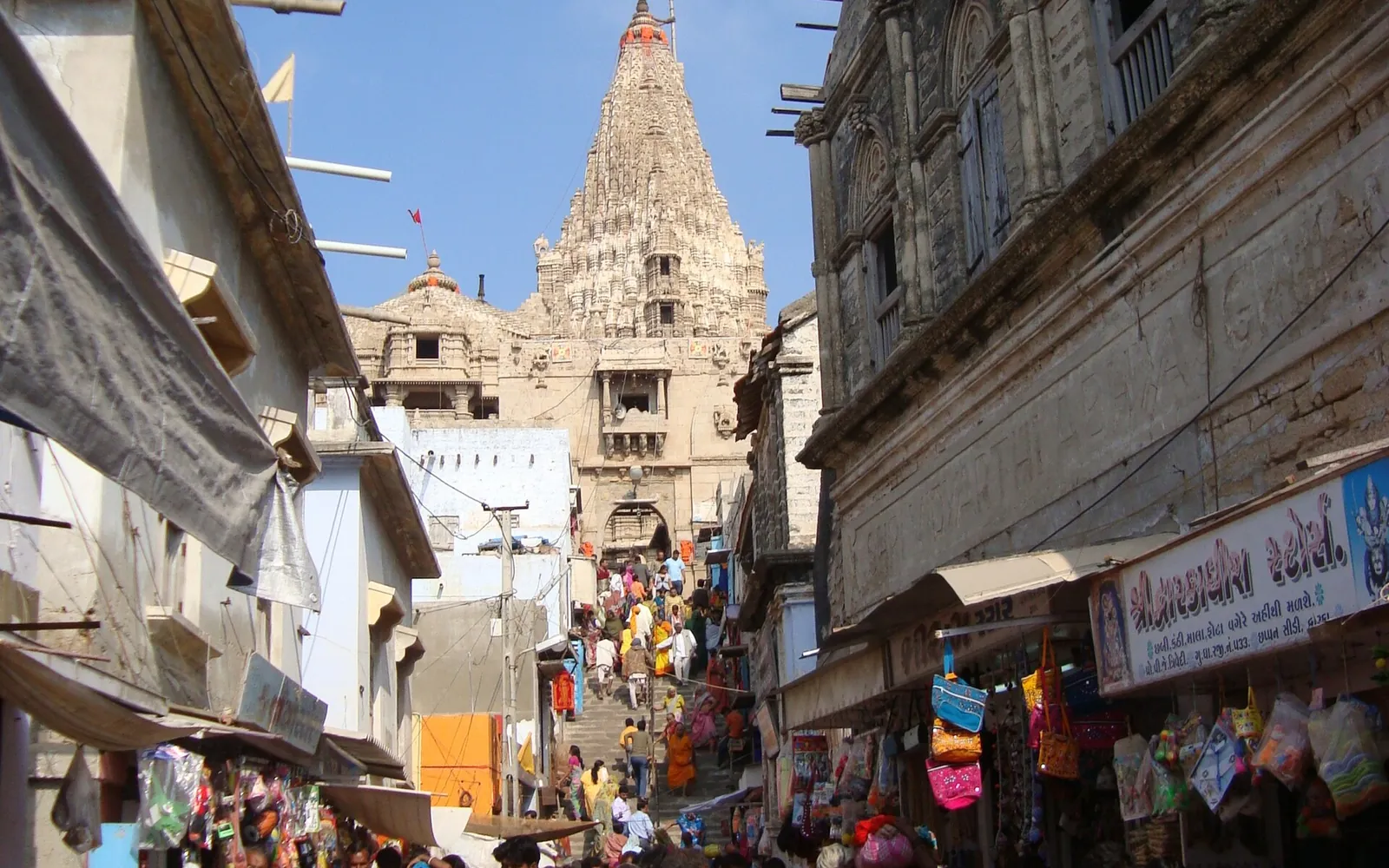
Janmashtami at Dwarkadhish Temple, What to Expect
Janmashtami at Dwarkadhish Temple in Dwarka is unlike any other festival celebration of Krishna's birth in India. Mathura and Vrindavan are better known internationally, but Dwarka, as the city where Krishna ruled as king and where his Char Dham temple stands, holds its own claim to being the definitive place to mark his birth. The festival unfolds over two to three days, with the primary celebration on the night of Ashtami (the eighth day of the waning moon in Bhadrapada). In 2026 this falls on approximately September 4-5.
The temple begins its special programmes a day or two before the main Ashtami night. Elaborate shringar (decoration) of the Dwarkadhish deity is the centrepiece, the idol is adorned with special ornaments, flower garlands of extraordinary complexity, and new vastra (garments) suited to the occasion. Continuous kirtan sessions fill the temple complex from evening. As midnight approaches, the traditional time of Krishna's birth, the atmosphere at the temple builds to extraordinary intensity. The Nishita Puja (midnight ritual) marks the exact moment of birth, accompanied by special arati, conch blowing, temple bells and the joyful cry of "Nand Gher Anand Bhayo" from thousands of gathered devotees.
The scale of the crowd at Dwarkadhish for Janmashtami is something that first-time visitors should prepare for carefully. With over 5 lakh pilgrims in Dwarka over these 2-3 days, the lanes around the temple, normally narrow and busy, become nearly impassable. Dwarkadhish Temple does not run any official "VIP darshan" or paid priority-queue scheme, unlike some other major temples such as Tirupati or Siddhivinayak that do offer paid fast-track passes. Every pilgrim, including elderly and disabled devotees, joins the same single general darshan queue, and general darshan itself has always been completely free. If you see touts, agents or unofficial websites near the temple or online offering a "VIP darshan pass" for Janmashtami, they are not affiliated with the Dwarkadhish Temple Trust, do not pay them. The Dwarka administration typically deploys additional police and crowd management for the festival period. Following the designated crowd flow and not attempting to push through designated barriers is both required by the authorities and essential for your own safety.
How to Plan Darshan During Janmashtami Week
The key to a meaningful Janmashtami darshan at Dwarkadhish is arriving early and planning your timing carefully. On the main Ashtami night, the temple complex fills rapidly from 6 PM onward. Pilgrims who want to be close to the sanctum for the midnight Nishita Puja should aim to be in position inside the temple complex by 9-10 PM at the latest, this means joining the queue by 7-8 PM. Arriving after 10 PM means you will experience the festival atmosphere from the outer courtyards or the lanes outside the temple, which is still a significant and moving experience but at a greater distance from the deity.
Darshan on the days immediately before Ashtami (Saptami and the preceding days) is much more manageable. The special shringar of the deity is in place from a day or two before the main night, and visiting on Saptami morning allows you to see the elaborately decorated Dwarkadhish in relative calm compared to the night itself. Many experienced Dwarka pilgrims actually prefer Saptami morning darshan to the Ashtami midnight press, the viewing of the decorated deity is more intimate and the Shringar Aarti at 7 AM on this day is performed with special attention.
For those who attend the midnight celebration, plan for the night in advance. Wear comfortable clothes (covering shoulders and knees per dress code), carry minimal belongings, and avoid bringing bags if possible as the crowd density makes them difficult to manage. Small children in large monsoon-night crowds at Dwarkadhish is not recommended, the festival is extraordinary but the physical conditions are demanding.
| Janmashtami Programme | Approximate Time | Notes |
|---|---|---|
| Special Shringar Aarti | Days before Ashtami | Elaborate deity decoration begins |
| Continuous Kirtan | Evening onwards | From 5-6 PM on Ashtami |
| Best time to enter temple | By 9-10 PM on Ashtami | For Nishita Puja proximity |
| Nishita Puja (birth celebration) | ~Midnight | Main midnight ritual, peak crowd |
| Post-midnight darshan | After 12:30 AM | Crowd begins to disperse slowly |
| Navami (day after) darshan | 6 AM onward | Calmer; deity still in special shringar |
Accommodation and Getting There for Janmashtami
Hotel rooms within walking distance of Dwarkadhish Temple, specifically in the 1-2 km radius, are the first to sell out for Janmashtami week, often within days of Janmashtami dates being confirmed (typically around March-April for August dates). By June, options close to the temple are typically exhausted. Hotels 3-5 km from the temple in Dwarka's outer areas and along the Okha road have longer availability but still require advance booking by June at the latest. Do not rely on walk-in availability for Janmashtami week.
Room rates during Janmashtami typically run 3-5 times the off-season price. A hotel room that costs ₹1,500 in July will be ₹4,000-7,000 during Janmashtami week. Budget accommodation (₹800-1,500 per night) is virtually unavailable in Dwarka proper during the festival, the nearest affordable options will be in towns 20-30 km out. Some pilgrims opt to come for a single day from Rajkot (215 km) or Jamnagar (141 km) by bus or train, skip overnight accommodation entirely, attend the midnight festival and return, a gruelling but workable approach for those determined to attend.
Transportation to Dwarka during Janmashtami week is heavily booked. The Dwarka Express from Ahmedabad and other trains fill months in advance. GSRTC buses see surging demand. If you are travelling from outside Gujarat, book your transport (train or bus) at the same time as your hotel, typically 3-4 months ahead. Private taxis from Rajkot or Jamnagar are available closer to the date but at premium rates.
August Outside Janmashtami, The Quiet Half of the Month
August has a split personality. The 4-5 days around Janmashtami are among the most crowded in Dwarka's entire year. But the rest of August, the weeks before and after the festival, are quieter than any month except July. Outside Janmashtami week, August in Dwarka has low tourist traffic, short darshan queues and affordable accommodation. The monsoon continues with temperatures of 26-33°C and regular heavy rain, exactly as in July.
Pilgrims who want to visit Dwarka in August but specifically want to avoid the Janmashtami crowds should plan their visit for the first week of August (before the festival) or from mid-August onward (after the crowds disperse). The Dwarkadhish aarti schedule is the same throughout August regardless of whether you come during or outside Janmashtami. The special atmosphere of the Janmashtami-decorated temple, with the enhanced shringar and heightened devotional energy, does linger for a few days after the main festival night, making the days immediately after Ashtami a sweet spot: special energy with rapidly decreasing crowds.
Bhadkeshwar Mahadev remains tide-dependent through August as the monsoon continues. Bet Dwarka ferry service operates with the same weather-dependent caveats as July. Nageshwar Jyotirlinga is fully accessible. ISKCON Dwarka holds its own Janmashtami celebrations, a different but equally vibrant experience in the Gaudiya Vaishnava tradition, making August the one month when both temples celebrate the same event simultaneously, offering pilgrims the chance to experience two distinct devotional styles of honouring Krishna's birth in a single visit.
The Spiritual Significance of Janmashtami in Dwarka
Janmashtami at Dwarka carries a dimension that no other location for this festival quite matches. Krishna was not born in Dwarka, he was born in Mathura, in prison, at midnight, during a violent storm. But Dwarka is where he chose to establish his kingdom after leaving Mathura and Vrindavan, and it is where his Char Dham temple, the principal axis of his pilgrimage geography, stands. Celebrating his birth here is not just commemorating an event but honouring the full arc of his life: from the birth that Mathura marks to the kingdom that Dwarka represents.
The Dwarkadhish Temple during Janmashtami is a living embodiment of this continuity. The same stone shrine that has stood here for centuries, rebuilt and renovated but continuously worshipped since the ancient period, receives the same midnight arati on Ashtami that it has received for generations of priests and pilgrims. When you stand before the Dwarkadhish deity during the Nishita Puja with half a million other pilgrims, you are participating in an unbroken chain of devotion that connects you to every pilgrim who has stood in this same place on this same night across the centuries.
For this reason, many pilgrims who have been to Mathura for Janmashtami and to Vrindavan for Janmashtami still consider the Dwarka Janmashtami the most complete experience of the festival, because it connects the birth (Mathura), the childhood (Vrindavan) and the kingdom (Dwarka) into a single whole. Those who can only come to Dwarka find that Dwarkadhish on Janmashtami night provides everything they need: the sense of celebrating at the centre of Krishna's sacred geography, the collective energy of lakhs of devotees, and the overwhelming beauty of the decorated deity at midnight.
Frequently Asked Questions
Also Read
Bet Dwarka
Guide to Bet Dwarka island: ferry from Okha, the Sudarshan Setu bridge, seasonal temple timings, and what to see on the island where Krishna lived.
Read Full GuideJanmashtami in Dwarka
The complete guide to Janmashtami at Dwarkadhish, celebrations, schedule, how to plan your visit, what to expect in the crowd and the significance of this festival at Krishna's Char Dham.
Read MoreDwarka in September
September in Dwarka, monsoon tapering, post-Janmashtami quiet, lush green landscape and peaceful darshan. What to expect the month after the festival rush.
Read MoreHotels in Dwarka
Where to stay in Dwarka, options near Dwarkadhish Temple, along the Gomti Ghat and on the outskirts, across budget and mid-range categories.
Read More