Dwarka in September: Quiet After Janmashtami, Green and Peaceful
September in Dwarka is a month of tapering monsoon and returning calm. The enormous Janmashtami crowd that fills the city in August disperses rapidly after the festival, leaving September as one of the quietest months of the year. Temperatures are 28-35°C, still warm but no longer the punishing summer heat. The landscape is at its greenest after the monsoon rains. Dwarkadhish Temple is fully open with all aratis. Darshan queues are short. This is a genuinely peaceful time to visit.
September Weather in Dwarka
September in Dwarka is a transitional month in the best sense. The intensity of the monsoon, which peaks in July and August, begins to ease. Rainfall becomes less frequent and lighter. By mid-September, there are days of clear sky with the post-monsoon freshness that characterises this part of the season in coastal Gujarat. Temperatures hover between 28°C and 35°C, which is warmer than the ideal October-February range but significantly more comfortable than the summer months. The humidity, while still present in early September, reduces progressively as the month moves on.
The Arabian Sea settles in September. The rough monsoon seas of July and August give way to calmer water, particularly in the latter half of the month. This has practical implications for Bet Dwarka ferry service and for the access path to Bhadkeshwar Mahadev. The tidal swells that make the Bhadkeshwar causeway hazardous in July and early August begin to normalise through September, and by late September the low-tide access windows are longer and more predictable.
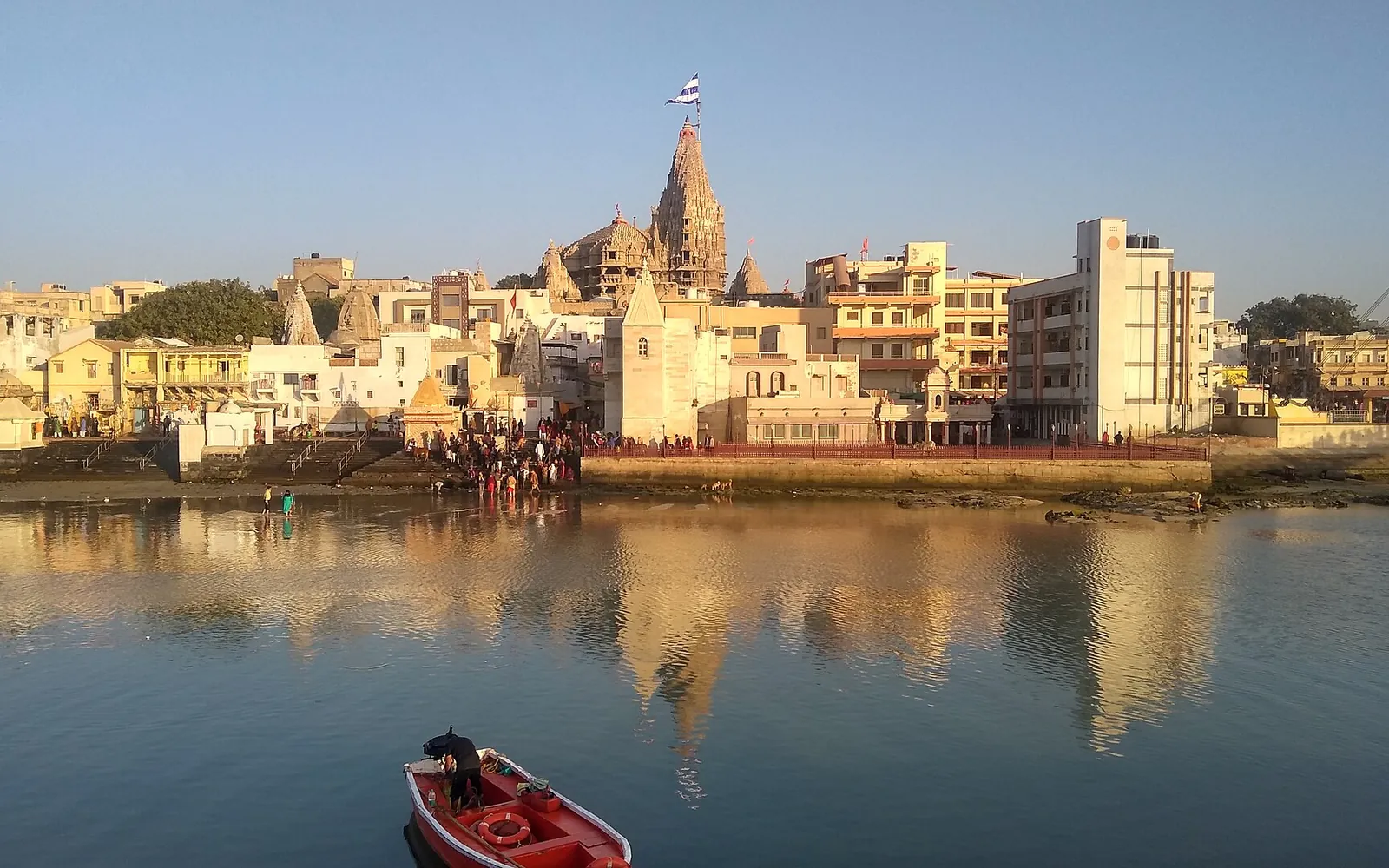
Dwarka's landscape is at its most lush in September. The Saurashtra region, normally dry and brown for most of the year, has absorbed three months of monsoon rain and the vegetation, scrub grass, coastal plants, the trees around the Gomti Ghat, is fully green. The river itself runs with a fullness it lacks in the dry season. For pilgrims who know Dwarka only from December visits, September offers a visually quite different version of the same sacred city: wet, green, atmospheric and almost entirely devoid of tourist crowds.
28-35°C, still humid, occasional rain, improving conditions
28-33°C, drier, clearer skies, best Bhadkeshwar access of monsoon months
Darshan at Dwarkadhish in September
Dwarkadhish Temple in September returns to the calm that defined it before the Janmashtami surge. The complete aarti schedule, Mangala at 6 AM, Shringar at 7 AM, Gwal at 8:30 AM, Rajbhog at 12 PM, Uthapan at 5 PM, Sandhya at sunset and Shayan at 9 PM, operates without any modifications. The festival decorations of Janmashtami are gradually removed and the deity returns to its standard darshan form through the first week of September.
Queue times at Dwarkadhish in September are very favourable, typically 45 minutes to 1 hour, in the single general darshan queue that every pilgrim uses. Compare this to the 2-4 hour queues of October-February peak season or the 6-8 hours on Janmashtami night itself, and September emerges as one of the most accessible months for unhurried darshan. Dwarkadhish has no official "VIP darshan" pass or paid fast-track counter, unlike some other major temples such as Tirupati or Siddhivinayak which do run such schemes, so anyone offering a paid "VIP darshan pass" near the temple or online is not affiliated with the Dwarkadhish Temple Trust and should not be paid. To keep your wait short, arrive for the 6 AM Mangala Aarti or soon after, queues are shortest between 6-7 AM and on weekday mornings. For pilgrims who want a slow, unrushed experience at the main sanctum, time to stand before the Dwarkadhish deity without the physical press of a large crowd, September provides this reliably.
The morning aratis in September are particularly pleasant. By 6 AM the air has cooled overnight (though not as dramatically as in December-January) and the light at sunrise over Dwarka has a clarity that the monsoon cloud cover of July-August obscures. The Shringar Aarti at 7 AM in September light, with the decorated deity and the temple's stone work catching the early sun, is one of the quieter and more beautiful experiences the temple offers. In October this time slot begins to fill with more pilgrims; September is a last window of relative solitude before the crowd build begins.
Bhadkeshwar, Bet Dwarka and Other Temples in September
Bhadkeshwar Mahadev Temple improves progressively through September. The monsoon tidal extremes of July-August ease, and by mid-to-late September the low-tide access window to the island causeway is longer and more reliable. In early September conditions are still similar to August, checking tide timings on the day remains essential. But from approximately mid-September onward, the causeway is accessible for 2-3 hours around low tide on most days, making a Bhadkeshwar visit a realistic plan rather than a contingency. By the end of September, Bhadkeshwar access is approaching the comfortable conditions of the October-February season.
Bet Dwarka ferry service from Okha becomes more reliable through September. The rough-sea days that could suspend the service in July and August are fewer in September. By late September, the ferry runs consistently unless there is an unusual weather event. The 36 km drive from Dwarka to Okha and the 20-30 minute ferry crossing feel much more comfortable in September than in the monsoon heart, less humidity, less chop on the crossing, and the island itself is lush and green from the rains.
All other Dwarka temples, Rukmini Devi, ISKCON, Nageshwar, Sudama Setu, operate on their normal schedules throughout September with no monsoon-related changes. Nageshwar Jyotirlinga (17 km from Dwarka) is completely unaffected by sea conditions and is accessible by road throughout September without any concerns. The special Rudrabhishek ritual at Nageshwar from 6-8 AM and the Evening Aarti at 7 PM both happen on schedule. A full-day Okha-Bet Dwarka-Nageshwar circuit is entirely practical in September, particularly from mid-month onward.
September as the Transition to the Best Season
September occupies a specific place in the Dwarka annual calendar: it is the bridge between the monsoon months (June-August) and the best season (October-February). Visiting in September means experiencing Dwarka at the edge of this transition, catching the last of the monsoon atmosphere while the city gears up for the months ahead. The Navratri festival in October marks the definitive start of the peak pilgrim season; September is the quiet before that beginning.
Hotel rates in September are still in the affordable range, closer to July-August monsoon prices than to the October-February peak. Rooms that cost ₹3,000-5,000 per night during Navratri or Janmashtami are available for ₹1,200-2,000 in September. Advance booking is not necessary as availability is high. This makes September a practical month for budget-conscious pilgrims who want a genuine Dwarka experience without peak-season costs or crowd pressure.
One consideration for October-Navratri planning: if you are visiting Dwarka in late September with the option to extend into early October, doing so to include the Navratri festival (approximately October 11-19, 2026) is worth considering. The transition from quiet September into the garba-filled Navratri celebration gives you the full spectrum of Dwarka's character, the contemplative and the celebratory, within a single extended visit. Book the October nights in advance if you make this choice, as Navratri hotel availability tightens quickly.
What to Pack and Practical Notes for September
September packing sits between the full monsoon kit of July-August and the light cotton of October-February. An umbrella or light rain jacket remains useful, particularly in early September when showers are still possible. Waterproof sandals are advisable for the first half of the month. By late September, regular comfortable sandals or shoes are fine on most days. The temperature range of 28-35°C is warm enough that light cotton clothing is appropriate throughout, no need for layers or a jacket.
The temple dress code applies as always, shoulders and knees must be covered for entry into Dwarkadhish, ISKCON, Rukmini Devi and all other major shrines. No leather items inside the temples. Mobile phones are not permitted in the main Dwarkadhish sanctum. Lockers at Swarga Dwar and Moksha Dwar (₹20-40) are operational and useful for depositing phones, footwear and excess belongings before entering the inner temple.
Food and accommodation are available and affordable throughout September. The Dwarka Trust Bhojnalaya near the temple offers free or nominal-cost meals to pilgrims. Local dhabas and restaurants in the market area near Dwarkadhish serve Gujarati thali and standard vegetarian food. The city is vegetarian by practice and pork and beef are not available anywhere in Dwarka. Non-vegetarian food of any kind is very difficult to find in the immediate temple area; the few places that serve it are on the town's periphery.
Frequently Asked Questions
Also Read
Bet Dwarka
Guide to Bet Dwarka island: ferry from Okha, the Sudarshan Setu bridge, seasonal temple timings, and what to see on the island where Krishna lived.
Read Full GuideDwarka in October
October brings Navratri and the start of the best season, pleasant weather, growing crowds, garba celebrations and the return of peak pilgrim energy to Dwarka.
Read MoreBest Time to Visit Dwarka
Month-by-month comparison of weather, crowd levels and festivals, helping you choose the right time for your Dwarka yatra.
Read MoreDwarka in August
August in Dwarka, Janmashtami festival with 5 lakh+ pilgrims, what to expect and how to plan darshan during the biggest event of the Dwarka calendar.
Read More