Dwarkadhish Rajbhog Aarti at 12 PM: Lord Dwarkadhish in His Finest Shringar
Rajbhog Aarti at Dwarkadhish Temple is at 12:00 PM every day. This is the noon offering, when the Lord is dressed in the richest decoration of the entire day and a full meal bhog is presented to the deity. The temple closes at 1:00 PM immediately after. Arrive by 11:30 AM to be inside before the doors close.
All Six Dwarkadhish Aartis in Order
| Aarti | Time | Significance |
|---|---|---|
| Dhwaja Ceremony | 5:00 AM | Sacred flag raised on the temple spire |
| Mangala Aarti | 6:00 AM | Lord awakened, first darshan of the day |
| Shringar Aarti | 7:00 AM | Lord dressed in morning attire |
| Gwal Aarti | 8:30 AM | Lord departs for grazing (symbolic) |
| Rajbhog Aarti | 12:00 PM | Noon meal offering, finest shringar |
| Temple Closes | 1:00 PM | Lord rests, vishram period begins |
| Uthapan Aarti | 5:00 PM | Lord awakened from afternoon rest |
| Sandhya Aarti | Sunset (~6-7 PM) | Evening lamp ceremony |
| Shayan Aarti | 9:00 PM | Lord put to rest for the night |
| Dhwaja Lowered | Sunset | Sacred flag lowered at day's end |
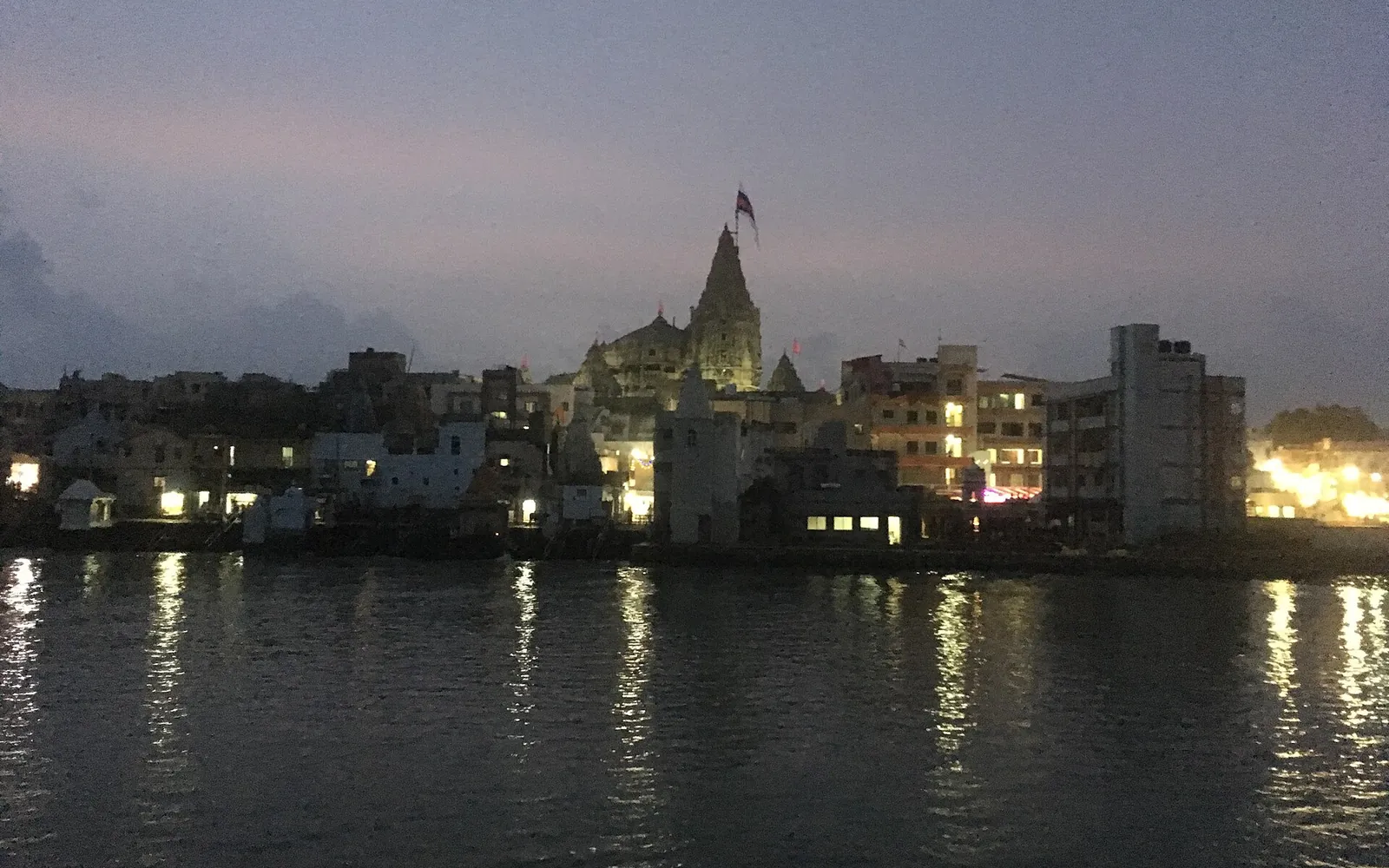
What Happens During Rajbhog Aarti
The Rajbhog Aarti at 12:00 PM is the culinary and sartorial centrepiece of the Dwarkadhish daily program. "Rajbhog" translates roughly as "royal feast", it is the noon meal presented to Lord Dwarkadhish in his role not merely as deity but as king. The theological premise of this aarti is specific: at midday, the Lord has returned from his symbolic morning activities (the Gwal Aarti at 8:30 AM represents his departure to tend to the cows), and it is time for the royal noonday meal.
The bhog (food offering) for Rajbhog is the most elaborate of the day, rice, multiple vegetable dishes, dal, chapati, sweets including peda and kheer, and seasonal fruits. The entire offering is arranged on large silver platters before the deity. The curtain is then drawn across the sanctum for a private offering period of approximately 20-30 minutes. When the curtain reopens, the Rajbhog Aarti proper begins: the priests perform the deepa aarti (waving of lamps) before the fully decorated deity while devotees press forward for darshan.
The shringar (decoration) at Rajbhog is the finest of the day. The Lord's garments are changed from the morning attire into the noon royal outfit, typically heavier silk, more elaborate jewellery, a larger crown, and fresh flower garlands. The idol of Lord Dwarkadhish (Trivikrama form, standing with arms raised) is adorned in a way that reflects the aesthetic conventions of medieval Gujarat temple decoration. Witnessing this particular shringar is considered distinctly auspicious, and many pilgrims who can only attend one darshan choose the Rajbhog window for this reason.
Why the Temple Closes at 1 PM and What That Means for You
Immediately after the Rajbhog Aarti concludes, around 12:30 PM to 1:00 PM, Dwarkadhish Temple closes for the afternoon. The theological reason is vishram: the Lord's afternoon rest. After his symbolic morning activities and the grand noon meal, the deity rests until 5:00 PM. The Uthapan Aarti at 5 PM marks the Lord's awakening from this rest.
This closure has major practical implications for pilgrims. If you are in the queue at 12:45 PM and have not yet crossed the gate threshold, you will not get in until 5:00 PM. The priests and security staff close the entrance promptly. There is no grace period and no exceptions, every pilgrim, regardless of who they are, moves through the same single general queue and is subject to the same cutoff. Dwarkadhish Temple has no paid VIP or priority ticket that would let you enter after the 1 PM closure.
The practical lesson is clear: if Rajbhog Aarti is your goal, be inside the temple complex by 11:30 AM. On busy days (weekends, festival season from October to February), even 11:00 AM entry may not guarantee that you see the aarti rather than just the post-aarti regular darshan. The queue at Dwarkadhish moves at its own pace and is not predictable. Building in an hour of buffer before any specific aarti you want to attend is the standard wisdom among experienced Dwarka pilgrims.
VIP Darshan and Queue Management for Rajbhog
Dwarkadhish Temple does not run any official "VIP darshan" scheme. There is no paid pass, no separate VIP counter, and no separate lane inside the temple. Every pilgrim, including elderly and disabled visitors and children, joins the same single general darshan queue, and general darshan at Dwarkadhish has always been completely free. This is a genuine point of difference from some other major temples, Tirupati and Mumbai's Siddhivinayak, for instance, do operate official paid priority-darshan schemes, but Dwarkadhish does not.
Because "VIP darshan" is a widely searched phrase, touts and unofficial websites sometimes offer a paid "VIP darshan pass" for Dwarkadhish near the temple or online. These have no connection to the Dwarkadhish Temple Trust, and pilgrims should not pay for one. If you want to see the crowded Rajbhog Aarti with minimal wait, the reliable approach is timing, not payment: arrive well before 12 PM, avoid October-February weekends and festival days when the general queue can run 2-4 hours, and prefer weekday mornings when the queue is at its shortest.
The Theology of the Rajbhog: Why a Noon Meal Offering Matters
Hindu temple worship operates on the principle of seva, service to the deity as a living royal presence. The Lord is not an abstract divinity to be approached through meditation alone; at Dwarkadhish, he is a king, a householder, a husband and father (in his Krishna form), and he requires the full ritual services a king would receive. This includes being woken at dawn, bathed, dressed, entertained through music and dance, fed at appropriate meal times, rested, awakened again, and finally put to bed at night.
The Rajbhog represents the central meal of this royal day. In the original tradition of the Pushtimarg sect, which has governed worship at Dwarkadhish for centuries, the 56 varieties of food (Chappan Bhog) presented to the deity at different times throughout the day and year represent the full range of human culinary offering to the divine. The noon Rajbhog is the most substantial of these offerings, corresponding to the main meal of the day when a king would have eaten in state.
For the pilgrim standing in the courtyard as the Rajbhog Aarti begins, this theology translates into a visible, sensory reality: the Lord dressed at his finest, lamps waving before him, the smell of fresh flowers and incense, the sound of conch shells and bells, and the collective press of hundreds of devotees straining for a glimpse of the decorated idol. Whatever your relationship to the theological underpinnings, the moment of Rajbhog darshan, the noon viewing of Lord Dwarkadhish in his royal noon shringar, is among the most charged experiences in the Char Dham pilgrimage circuit.
Frequently Asked Questions
Also Read
Gwal Aarti Time
Dwarkadhish Gwal Aarti is at 8:30 AM daily, the quieter mid-morning darshan between Mangala and Rajbhog.
Read Full GuideSandhya Aarti Time
Dwarkadhish Sandhya Aarti is held around sunset, about 6 PM in winter and 7 PM in summer.
Read Full GuideShayan Aarti Time
Dwarkadhish Shayan Aarti is at 9:00 PM, the last, quietest darshan of the day.
Read Full GuideDwarkadhish Temple Timings
The complete Dwarkadhish schedule, all six aartis from Mangala at 6 AM to Shayan at 9 PM, the Dhwaja ceremony, and the temple closure pattern.
Read MoreDwarkadhish Temple
The full guide to Dwarkadhish, its history as Char Dham, the architecture, the Trivikrama idol, and what makes darshan here different from any other temple.
Read MoreDwarka Darshan Itinerary
Plan your full Dwarka visit around the Dwarkadhish aarti schedule, morning ghat bath, Rajbhog darshan, afternoon excursion, and evening Sandhya aarti.
Read More