Dwarkadhish Gwal Aarti at 8:30 AM: The Quiet Window Between Mangala and Rajbhog
Gwal Aarti at Dwarkadhish Temple is at 8:30 AM every day. It sits in the calm stretch of the morning between the crowded 6 AM Mangala Aarti and the noon rush for Rajbhog, a shorter, quieter ceremony marking the Lord's symbolic departure as a cowherd. Arrive by 8:15 AM to walk into one of the least hurried darshan windows the temple offers.
All Ten Stages of the Dwarkadhish Daily Schedule
| Aarti | Time | Significance |
|---|---|---|
| Dhwaja Ceremony | 5:00 AM | Sacred flag raised on the temple spire |
| Mangala Aarti | 6:00 AM | Lord awakened, first darshan of the day |
| Shringar Aarti | 7:00 AM | Lord dressed in morning attire |
| Gwal Aarti | 8:30 AM | Lord departs for grazing (symbolic) |
| Rajbhog Aarti | 12:00 PM | Noon meal offering, finest shringar |
| Temple Closes | 1:00 PM | Lord rests, vishram period begins |
| Uthapan Aarti | 5:00 PM | Lord awakened from afternoon rest |
| Sandhya Aarti | Sunset (~6-7 PM) | Evening lamp ceremony |
| Shayan Aarti | 9:00 PM | Lord put to rest for the night |
| Dhwaja Lowered | Sunset | Sacred flag lowered at day's end |
What Happens During Gwal Aarti
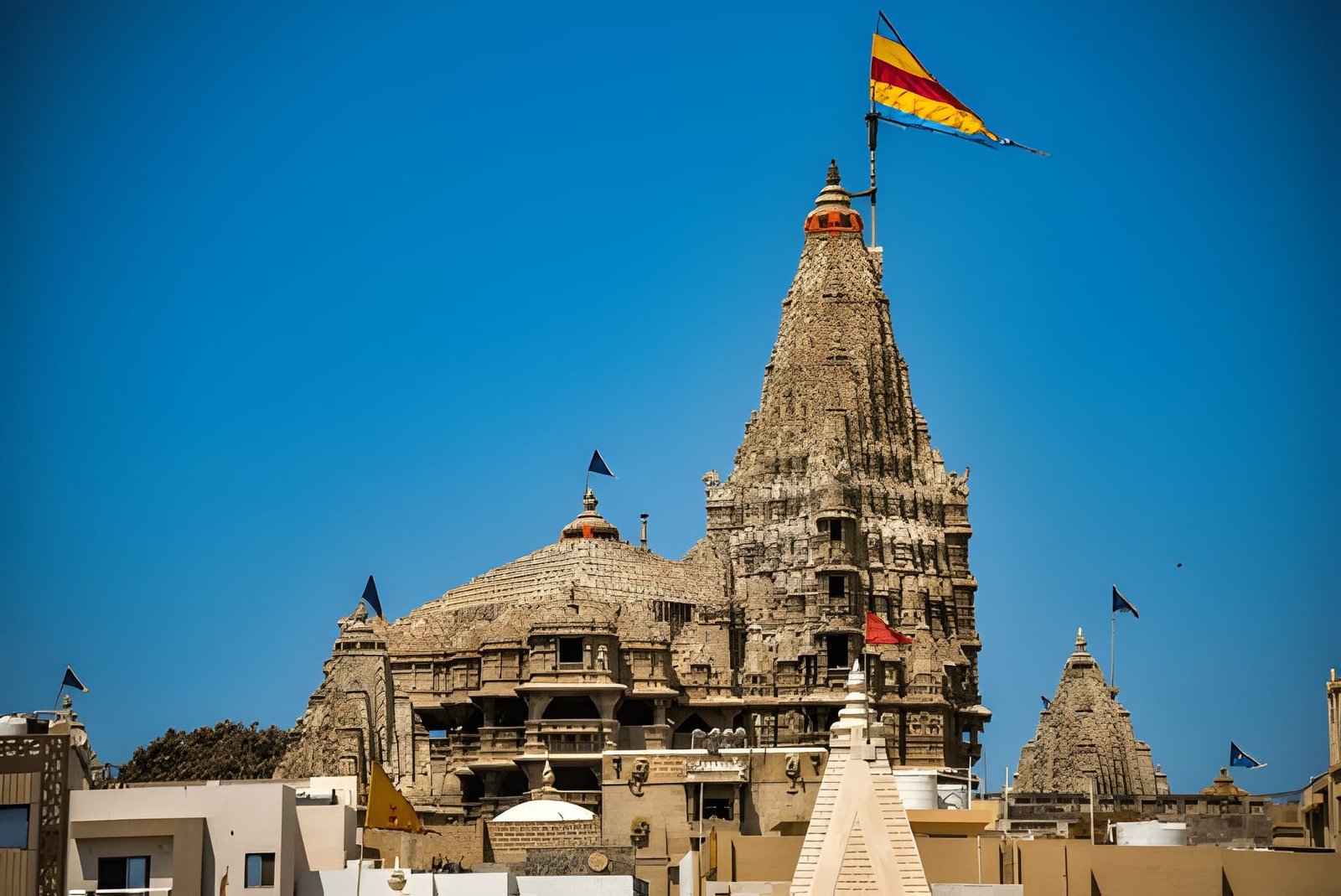
"Gwal" means cowherd, and the aarti held at 8:30 AM each morning at Dwarkadhish Temple carries that meaning directly into its ritual. By this hour, Lord Dwarkadhish has already been woken at Mangala Aarti and dressed for the day at Shringar Aarti. Gwal Aarti marks the next symbolic beat in his daily routine: the moment he is considered to set out, in his form as a cowherd boy, to tend and graze the cows.
This is a distinctly Krishna-flavoured moment inside a temple that otherwise emphasises Dwarkadhish's identity as king and ruler of Dwarka. Before he built his kingdom on the western coast of Gujarat, Krishna spent his childhood and youth in Vrindavan and Gokul, herding cattle among the gopas and gopis. Gwal Aarti is the daily ritual reminder of that pastoral life, a brief return, each morning, to the cowherd boy beneath the king.
Compared to Mangala or Rajbhog, the ceremony itself is modest. The priests perform a shorter round of lamp-waving before the deity, without the elaborate shringar change or food offering that accompanies the bigger aartis. There is no fresh change of royal attire at this point in the day, the Lord remains in the morning shringar set at 7 AM. The brevity and simplicity of Gwal Aarti are part of its character: it is a working ritual, tucked into the temple's mid-morning rhythm, rather than a grand public spectacle.
Why 8:30 AM Is the Quiet Window Most Pilgrims Miss
Most first-time visitors to Dwarkadhish Temple plan their day around only two windows: the 6 AM Mangala Aarti, because it is the first darshan and widely recommended, and the 12 PM Rajbhog Aarti, because it is the most decorated. Both of these draw substantial crowds. Mangala Aarti sees devotees queuing from well before 5:30 AM, and the press of people at the sanctum door can be considerable. Rajbhog sees a similar surge from around 11:00 AM onward as pilgrims try to be inside before the 1 PM closure.
Gwal Aarti at 8:30 AM sits in the gap between these two rushes. By 8 AM, the Mangala crowd has largely dispersed, many visitors leave the temple complex after the 6 AM ceremony to have breakfast or move on to Gomti Ghat and other nearby sites. The Rajbhog crowd has not yet begun to build; that surge typically starts closer to 10:30 or 11 AM. This leaves a genuine lull in foot traffic through the temple's inner courtyard between roughly 7:30 AM and 10 AM, and Gwal Aarti falls squarely inside it.
For a pilgrim who wants a calmer, less physically demanding darshan experience, enough time to actually look at the idol and take in the ceremony rather than being swept along by a crowd, the 8:30 AM Gwal Aarti is one of the better-kept practical secrets of the Dwarkadhish schedule. It won't have the emotional intensity of Mangala's pre-dawn hush or the visual richness of Rajbhog's full royal shringar, but it offers something neither of those can: room to breathe.
Arrive by 8:15 AM to be safely inside before the ceremony begins. This gives enough buffer to pass through the security checkpoint, deposit any prohibited items at the locker counters near Swarga Dwar or Moksha Dwar, and find a comfortable spot in the courtyard before the priests begin the aarti. Unlike the Mangala or Rajbhog windows, there is rarely a need to arrive an hour or more in advance, 15 minutes of buffer is typically sufficient on a normal day.
VIP Darshan and Queue Management for Gwal Aarti
Dwarkadhish Temple does not operate an official VIP darshan or paid priority-queue scheme, this is unlike some other major temples, such as Tirupati or Siddhivinayak, which do sell official passes for faster entry. At Dwarkadhish there is no ₹200 ticket, no separate counter, no token, and no separate lane; every pilgrim, including elderly and disabled devotees, joins the same single general queue at Swarga Dwar.
The good news is that this matters far less for Gwal Aarti than it might for the two bookend ceremonies. Because the 8:30 AM window sees comparatively light footfall, the general queue at this hour is usually short enough that most pilgrims move through without significant delay, often 15 to 30 minutes on a normal day, and rarely more than 45 minutes even during the October-to-February peak season. Arriving by 8:15 AM, before the crowd from Rajbhog begins to build, is the simplest way to keep the wait short.
If anyone near the temple, at Swarga Dwar, or on a website offers a paid "VIP darshan pass" for Gwal Aarti or any other aarti, they are not affiliated with the Dwarkadhish Temple Trust; do not pay them. The same practical rules that apply throughout the day at Dwarkadhish apply here too: no leather items inside the sanctum, no shorts or sleeveless clothing, and lockers available for ₹20-40 at the main entrances.
The Full Rhythm of the Day: Where Gwal Aarti Fits
Understanding Gwal Aarti fully means seeing it as one link in a longer chain. The Dwarkadhish daily schedule treats the deity as a living royal presence with a full day's routine: woken at dawn (Mangala, 6 AM), dressed for the morning (Shringar, 7 AM), sent out for pastoral duties (Gwal, 8:30 AM), fed the grand noon meal (Rajbhog, 12 PM), rested through the afternoon behind closed doors (1 PM to 5 PM), woken again (Uthapan, 5 PM), honoured at dusk with lamps (Sandhya, sunset), and finally put to bed for the night (Shayan, 9 PM). The Dhwaja, the sacred flag on the temple spire, is raised at dawn and lowered at sunset, bookending the entire cycle.
Within this structure, Gwal Aarti is the pivot between the temple's identity as a place of intimate morning worship and its identity as a royal court preparing for the day's grandest ceremony. It is also, for the pilgrim planning a single day in Dwarka, a useful anchor point: if the plan is to see Mangala Aarti at 6 AM, spend two hours at Gomti Ghat or the Bet Dwarka ferry queue, and still make it back in time for Rajbhog at noon, Gwal Aarti at 8:30 AM is a natural, low-friction stop to build into that itinerary, a five-minute detour back into the temple that adds meaningfully to the day's darshan without costing much time.
Pilgrims who have the flexibility to attend more than one aarti often report that Gwal Aarti, precisely because it asks so little of them in terms of crowd tolerance and waiting time, becomes an unexpectedly memorable part of the visit, a moment of quiet devotion sandwiched between two much louder ones.
Frequently Asked Questions
Also Read
Dwarkadhish Temple Timings
The complete Dwarkadhish schedule, all aartis from Mangala at 6 AM to Shayan at 9 PM, the Dhwaja ceremony, and the temple closure pattern.
See Full Aarti ScheduleDwarkadhish Rajbhog Aarti Time
The noon aarti at 12 PM, the finest shringar of the day, the royal meal offering, and why the temple closes at 1 PM right after.
Read Rajbhog Aarti GuideDwarkadhish Mangla Aarti Time
The first darshan of the day at 6 AM, when Lord Dwarkadhish is awakened. Queue forms from 5:30 AM; what to expect and when to arrive.
Read Mangla Aarti Guide