Restaurants Near Dwarkadhish Temple: All Vegetarian, All Within Walking Distance
Every restaurant in the market lane next to Dwarkadhish Temple is strictly vegetarian. The 300-400m bazaar between Swarga Dwar and the main road holds the best eating options in Dwarka: Gujarati thali at ₹80-150, dal baati churma, fafda-jalebi for breakfast, and freshly made kachori all day.
Useful References
Why Every Restaurant Near the Temple Is Vegetarian
If you are wondering whether there is any non-vegetarian food available near Dwarkadhish Temple, the answer is an unambiguous no, and understanding why helps you appreciate the sacred character of this city before you even arrive. Dwarka is one of the four sacred Char Dhams of Hinduism and one of the seven Sapta Puris (most sacred cities in the Hindu tradition). Lord Dwarkadhish is a Vaishnavite deity, a form of Lord Vishnu or Krishna, and the Vaishnava tradition places vegetarianism not as a dietary preference but as a core spiritual and ethical practice. To eat meat is considered incompatible with the bhakti (devotional) mindset that the pilgrim is expected to cultivate during the Dwarka yatra.
This is not a rule enforced by any single sign or authority, it is a deeply internalized social norm observed by the entire local community, the priests, the shopkeepers and the restaurant owners who have lived in Dwarka for generations. The temple trust has historically exercised some degree of oversight over commercial activity in the immediately surrounding area, and that influence reinforces the vegetarian character of the market lane. But more fundamentally, any restaurant owner who attempted to sell non-vegetarian food near Dwarkadhish Temple would face immediate and decisive social disapproval from their neighbours, their customers and the community. The norm is self-enforcing and has been so for as long as anyone in Dwarka can remember.
The vegetarian character of Dwarka extends beyond simply the absence of meat. In many establishments near the temple, particularly those that cater heavily to Vaishnava pilgrims, onion and garlic are also avoided. These two ingredients are classified in Ayurvedic and Vaishnava cooking traditions as rajasic (stimulating) or tamasic (dulling) foods that are considered incompatible with the spiritual clarity and mental stillness that pilgrimage is intended to cultivate. Visitors who require onion and garlic in their food will find them available in restaurants slightly further from the temple, but in the innermost market lane, sattvic cooking without these ingredients is the default.
"In Dwarka, vegetarianism is not a menu option, it is the only option. Every stall, restaurant and sweet shop within walking distance of Dwarkadhish Temple serves exclusively pure vegetarian food."
The Market Bazaar: Where to Eat Near Dwarkadhish Temple
The most important thing to know about eating near Dwarkadhish Temple is the geography of the market lane. Stretching approximately 300-400 metres between the Swarga Dwar (the principal northern gate of the temple precinct, through which pilgrims exit after darshan) and the main road where auto-rickshaws and taxis drop visitors, this compact bazaar is the beating heart of the pilgrim economy in Dwarka. It is dense, lively and always busy during temple hours, and it contains the majority of the eating options that pilgrims use.
The lane is lined on both sides with a layered ecosystem of food establishments. At the most permanent and established end are the sit-down restaurants, proper restaurants with tables, chairs and a full menu. These establishments serve the core meal options: Gujarati thali, dal baati churma, and a la carte items. Alongside the restaurants are sweet shops, which sell pedas, basundi, ghughra and other traditional Gujarati and Rajasthani sweets both as prasad-style souvenirs to carry home and as desserts to eat on the spot. And at the most informal and immediate end of the spectrum are the stall-based vendors selling freshly fried kachori, hot fafda, and paper cups of chai, food designed to be eaten standing at the counter, quickly, between the temple gate and the road.
Navigating this lane is straightforward: walk out of Swarga Dwar after darshan and start walking toward the main road. The smells of hot ghee, fresh rotli and sweet chai will guide you. Most pilgrims eat here after morning darshan (between 9 AM and 12 PM) or after the evening aarti (between 7:30 PM and 9:30 PM). The lane is busy but manageable outside these peaks.
Best Restaurants Near Dwarkadhish Temple
Shreenathji Restaurant
The most well-known restaurant in the market lane and the default choice for the majority of pilgrims visiting Dwarkadhish Temple. Shreenathji draws heavily from Gujarat, Rajasthan and Maharashtra, the three states that send the largest numbers of pilgrims to Dwarka, and its menu reflects that multi-regional Vaishnavite palate. The full Gujarati thali is served at ₹100-150 and is unlimited, meaning rotli, dal and sabzi are refilled as long as you are eating. The a la carte menu includes kachori, poha, dal baati churma, and seasonal preparations. The restaurant is typically very crowded from 9 AM to 2 PM during the lunch rush and again from 7 PM to 9 PM in the evenings. Arrive slightly before these peaks for a comfortable seat.
Gokul Restaurant
Another reliable and well-patronised option in the market bazaar. Gokul runs a similar menu to Shreenathji, Gujarati thali, dal baati, breakfast items, but is generally slightly cheaper and slightly less crowded, making it a practical alternative when Shreenathji has a long wait. The thali here is priced toward the lower end of the ₹80-100 range. The service is quick and the portions are generous. Gokul is particularly popular with pilgrims who are on a tight budget or travelling in large family groups where cost per head adds up quickly. Reliable, clean, and fast, exactly what most pilgrims need after a tiring morning in the temple queue.
Market Lane Thali Restaurants (Multiple)
Beyond these two named establishments, the market lane contains several smaller, family-run thali operations that are not individually famous but serve consistently good food at the same price points. These tend to be simpler in decor, often just a few benches and a counter, but the food is freshly made and entirely in keeping with the pilgrimage food tradition. Look for the places where local families and returning pilgrims are seated; these are reliable indicators of quality. Many of these smaller establishments also have a separate sweets section at the front where you can pick up peda or basundi to eat as dessert after your thali.
Breakfast and Snack Stalls (Multiple)
The market lane hosts several dedicated breakfast and snack stalls that operate from early morning and serve individual items rather than full meals. These stalls are the best place for the pre-darshan breakfast ritual: fafda (crispy fried chickpea strips) with fresh hot jalebi (syrup-soaked fried spirals), a combination that is so ubiquitous in Gujarat that it is practically the state's morning meal. These stalls also serve poha (flattened rice with mustard seeds, turmeric, onion, or without onion in the more sattvic versions), khaman (steamed gram flour cakes garnished with mustard seeds and coriander), and sev-usal (a thick pea curry topped with noodle-like sev). Prices are ₹20-30 per item, making breakfast the most affordable meal of the day.
Gujarati Thali: The Complete Pilgrim Meal
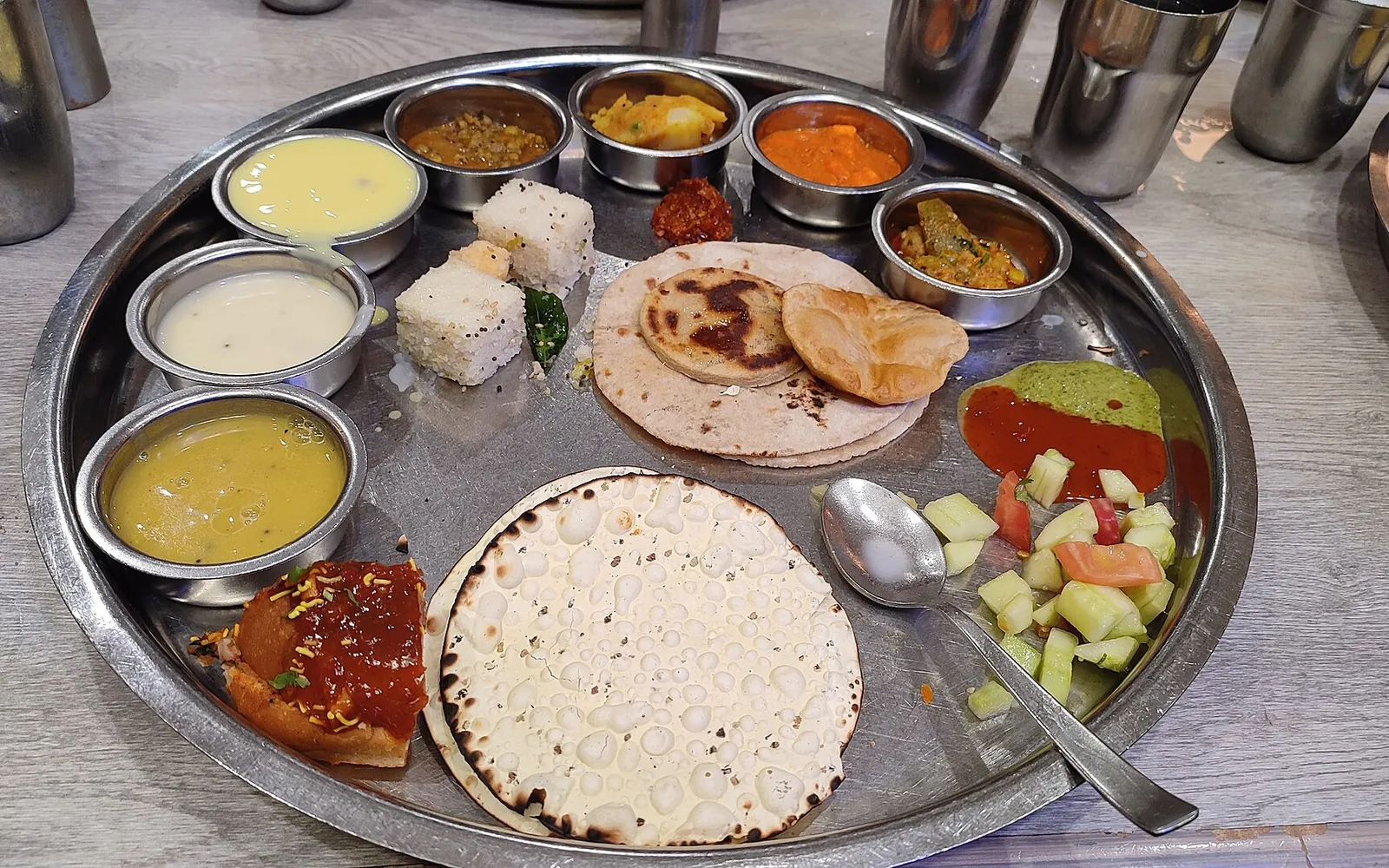
The Gujarati thali is the defining food experience near Dwarkadhish Temple and the meal that the majority of pilgrims eat at least once, often twice, during their time in Dwarka. Understanding what a thali is and what to expect helps you appreciate and navigate this meal with confidence. A full Gujarati thali arrives at the table as a large steel plate lined around the perimeter with small katoris (metal bowls), each containing a different preparation. The components vary slightly day to day as sabzis rotate with the season and the cook's preference, but the essential structure remains consistent.
The core elements of a Gujarati thali near Dwarkadhish Temple: dal (a lentil soup, in Gujarat, this is typically slightly sweet and mildly spiced, a notable contrast to the more pungent Punjabi or Maharashtrian dal); kadhi (a warming, slightly thickened buttermilk and besan curry that is one of the most characteristic flavours in Gujarati cooking, gently sweet, mildly sour, aromatic with curry leaves and mustard seeds); two or three sabzis (vegetable preparations, often including a potato preparation, a green vegetable and sometimes a more complex preparation like undhiyu or a seasonal specialty); rotli (thin, soft wheat flatbreads made to order and served hot); puri (deep-fried wheat flatbreads, richer than rotli and especially popular with children); steamed white rice; papad (crisp lentil wafers, served fried or roasted); chhaas (fresh buttermilk, thin and cooling, served in a separate glass or a large katori); and a sweet dish, most commonly shrikhand (thick, strained yogurt flavoured with saffron and cardamom, slightly sweet and dense) or gulab jamun (soft fried milk-solid dumplings in sugar syrup).
The thali is unlimited. Once you are seated, the server will continue to refill rotli, dal and sabzi as long as you want more. This practice, deeply embedded in the culture of bhojanshala-style pilgrim restaurants, means there is no pressure to eat quickly and no anxiety about running out of food. At ₹80-150 per person, the Gujarati thali is the best-value full meal available anywhere in Dwarka and the most efficient way to eat well, quickly, and for a reasonable price after a long morning of darshan.
Dal Baati Churma: Rajasthani Influence Near the Temple
One of the more distinctive and flavourful food experiences near Dwarkadhish Temple is dal baati churma, a Rajasthani preparation that has become firmly established in the Dwarka restaurant repertoire due to the very large numbers of Rajasthani pilgrims who visit Dwarkadhish Temple every year. Dwarka is one of the sacred sites on the Rajasthani pilgrim circuit, many Rajasthani families undertake a combined yatra that includes Dwarka, Somnath, Nathdwara and Pushkar, and where Rajasthani pilgrims travel, Rajasthani food follows. The restaurants in the market lane near Dwarkadhish Temple have adapted their menus accordingly, and dal baati churma is now as standard an offering in this bazaar as the Gujarati thali itself.
Baati are hard, round, unleavened wheat balls that are traditionally baked in a wood-fired clay oven (chulha) or buried in the embers of a fire and allowed to bake slowly. In the restaurants near Dwarkadhish Temple, baati are most commonly prepared in a gas-fired tandoor. The baati emerges from the oven as a dense, golden-brown sphere with a hard crust and a slightly doughy interior. It is then broken open, doused generously with melted ghee, and served alongside a thick, robustly spiced dal, typically a combination of five lentils (panch-dal) seasoned with dried red chillies, coriander, and a tempering of ghee and cumin. The churma completes the trio: crushed baati mixed with generous amounts of ghee and either jaggery (gur) or sugar to create a rich, sweet, crumbly mixture that is eaten in small quantities alongside the savoury dal and baati as a palate counterpoint. A full plate of dal baati churma in the market lane costs ₹80-120.
Breakfast Options Near Dwarkadhish Temple
-
1
Fafda-Jalebi (₹20-30)
The quintessential Gujarat morning meal and the most popular pre-darshan breakfast in the market lane. Fafda are long, crispy fried chickpea-flour strips seasoned with carom seeds (ajwain) and black pepper; jalebi are deep-fried wheat-flour spirals soaked in hot sugar syrup, yielding a crunchy exterior and a syrupy core. The combination of savoury-crispy fafda with sweet-syrupy jalebi is a textural and flavour contrast that is deeply satisfying at 7 AM before a long morning in the temple. Available from the first stalls to open, typically by 7:00-7:30 AM, and often sold out by 10 AM.
-
2
Poha (₹20-30)
Flattened rice cooked with mustard seeds, turmeric, green chilli, curry leaves, lemon juice and fresh coriander. Light, easy to digest, and warming, an ideal early morning meal before a physically active morning of temple darshan. The version served in the market lane near Dwarkadhish Temple is typically made without onion (keeping it sattvic), garnished with sev and fresh coriander.
-
3
Khaman (₹20-25)
Steamed gram flour cakes (khaman dhokla) garnished with a tempering of mustard seeds, sesame seeds, curry leaves and green chilli, topped with fresh coriander and grated coconut. Soft, spongy, mildly sour and slightly sweet, one of the most versatile and beloved dishes in Gujarati cooking. Particularly popular as a light, easily digestible breakfast before the morning temple visit.
-
4
Sev-Usal (₹25-35)
A hearty, protein-rich breakfast of thick pea curry (usal) topped generously with noodle-like fried chickpea-flour sev, diced onion (optional), fresh lemon juice and coriander. Sev-usal is more filling than fafda or poha and is preferred by pilgrims who anticipate a long morning of darshan and want a breakfast that will sustain them through the wait.
-
5
Kachori (₹15-20 each)
Deep-fried pastry shells stuffed with a spiced filling, most commonly moong dal (dried green lentils ground with spices) or matar (green peas). Kachori is available throughout the day from the stalls in the market lane but is freshest and most popular in the morning. Hot kachori with sweet tamarind chutney and spicy green chutney is a universally loved street snack at ₹15-20 per piece.
Street Snacks Near Gomti Ghat (400m from Temple)
A 400-metre walk from the main temple gate brings you to Gomti Ghat, the sacred confluence of the Gomti River and the Arabian Sea. The lanes around the ghat and the embankment itself host a different category of food vendors: more casual, more mobile, and oriented toward snack food rather than full meals. These are the stalls pilgrims gravitate to after the evening aarti, for an inexpensive post-ritual snack while the spiritual mood of the ceremony still lingers.
- Dabeli (₹15-20) Spiced mashed potato filling in a soft pav bun with pomegranate seeds, peanuts and sev, a Kutch specialty that has spread across all of coastal Gujarat
- Bhajiya (₹10-20) Gram-flour battered and fried fritters, potato, onion, chilli or brinjal, hot and crispy, best eaten immediately with green chutney
- Kachori at Ghat (₹10-15) Slightly cheaper than market lane versions, freshly fried in small batches throughout the evening
- Fresh Coconut Water (₹20-30) Sold from carts throughout the ghat area, refreshing after morning darshan and the walk back from the temple
- Chai (₹10-15) Strong, milky, heavily sweetened masala chai from roadside vendors, the default beverage at every hour of the day near the ghat
Restaurant Timings Near Dwarkadhish Temple
Understanding the rhythm of restaurant activity near Dwarkadhish Temple helps you plan your meals efficiently and avoid long waits. The pattern is driven directly by temple darshan timings: pilgrims eat before or after their darshan slot, creating predictable peaks that cluster around the temple's opening times.
| Meal / Period | Timing | Notes |
|---|---|---|
| Breakfast (stalls) | 7:00 AM – 10:30 AM | Fafda-jalebi, poha, kachori, arrive early, sells out fast |
| Lunch Peak | 12:00 PM – 2:00 PM | Most crowded; temple closes 12:30 PM so pilgrims flood into restaurants |
| Afternoon Lull | 2:00 PM – 5:00 PM | Some restaurants close 3-5 PM; stalls remain open; best time for a quiet thali |
| Dinner Peak | 7:30 PM – 9:00 PM | After evening aarti at temple and Gomti Ghat; very busy |
| Late Evening | 9:00 PM – 10:00 PM | Most restaurants closing; a few snack stalls still operating near ghat |
| Most Restaurants Close | 10:00 PM – 10:30 PM | Very little food available after 10:30 PM |
Sweets Shops: Prasad, Dessert and Souvenirs
The sweet shops (mithai shops) in the market lane near Dwarkadhish Temple occupy an interesting dual role in the Dwarka food ecosystem: they serve both as dessert counters for pilgrims who have just eaten a thali and want something sweet to finish with, and as prasad shops where devotees purchase sweets to carry home as religious gifts for family members who could not make the pilgrimage. This prasad function means that the sweets shops are more deeply embedded in the temple culture than a typical urban sweet shop would be, the quality and sanctity of the sweets matters to their religious value, not just their taste.
The most popular sweets available near Dwarkadhish Temple include: Peda (a dense, milk-based fudge flavoured with cardamom and saffron; Mathura peda is the classic pilgrimage prasad form); Basundi (thickened sweetened milk with saffron, cardamom and nuts, served warm or at room temperature); Ghughra (crispy deep-fried pastry pockets filled with a sweet coconut and dry-fruit filling, a distinctly Gujarati sweet especially popular during festivals); and Shrikhand (thick strained sweetened yogurt with saffron and cardamom, available in cups to eat on the spot). Prices are reasonable: pedas at ₹5-10 each, basundi cups at ₹30-50, and ghughra at ₹10-20 per piece. Boxed assortments for carrying home as prasad are available at ₹100-500 depending on size and contents.
What to Avoid and Hygiene Advice
- Inside the Temple Eating or drinking inside the temple premises is not permitted. Consume all food before entering or after exiting.
- Non-Veg Food Do not bring any non-vegetarian food anywhere near the temple area. It is deeply disrespectful, practically impossible to source locally, and would cause significant social offence.
- Cut Fruit Carts Roadside vendors selling pre-cut fruit in the open air are best avoided, especially during monsoon season (June-September) when humidity accelerates spoilage.
- Uncovered Items Avoid any food that has been sitting out uncovered for long periods. Opt for freshly made items from stalls with high customer turnover.
- Drinking Water Purchase sealed bottled water; tap water and water from roadside stalls should be avoided. Gomti River water is sacred for bathing, not for drinking.
- Established Restaurants Sit-down restaurants near Dwarkadhish Temple serve lakhs of pilgrims annually and are generally clean and safe. Avoid unpopular or visibly unhygienic carts.
Frequently Asked Questions
Also Explore Dwarka Food & Temple
Locker Facility
Dwarkadhish Temple lockers are at both gates, Swarga Dwar and Moksha Dwar.
Read Full GuideDwarka Food Guide
Complete guide to all food in Dwarka, temple prasad, thali restaurants, ISKCON Govinda's, street food and dharamshala meals.
Read Food GuideDwarka Local Food
What locals in Dwarka actually eat, beyond the standard pilgrim thali, the real everyday Gujarati and coastal food culture of Dwarka.
Explore Local FoodGomti Ghat Dwarka
Sacred confluence of the Gomti River and Arabian Sea, 400m from the temple. Evening Sandhya Aarti at sunset and the best casual street snacks in Dwarka.
Read Gomti Ghat GuideDwarkadhish Temple Guide
Complete guide to the Char Dham temple of Lord Krishna, timings, darshan, aarti, dress code and how to plan your visit.
Read Temple Guide