Sudama Setu to Dwarkadhish Temple: 0.8 km Walk Along the Sacred Gomti
Sudama Setu to Dwarkadhish Temple is 0.8 km, a 10-minute walk along the Gomti River. Cross the bridge for aerial views of Gomti Ghat and the 56 kunds below, then follow the riverbank lane directly to the temple precinct. The bridge and the walk together make for one of the most unhurried, beautiful approaches to Dwarkadhish.
Sudama Setu, The Bridge and Its Significance
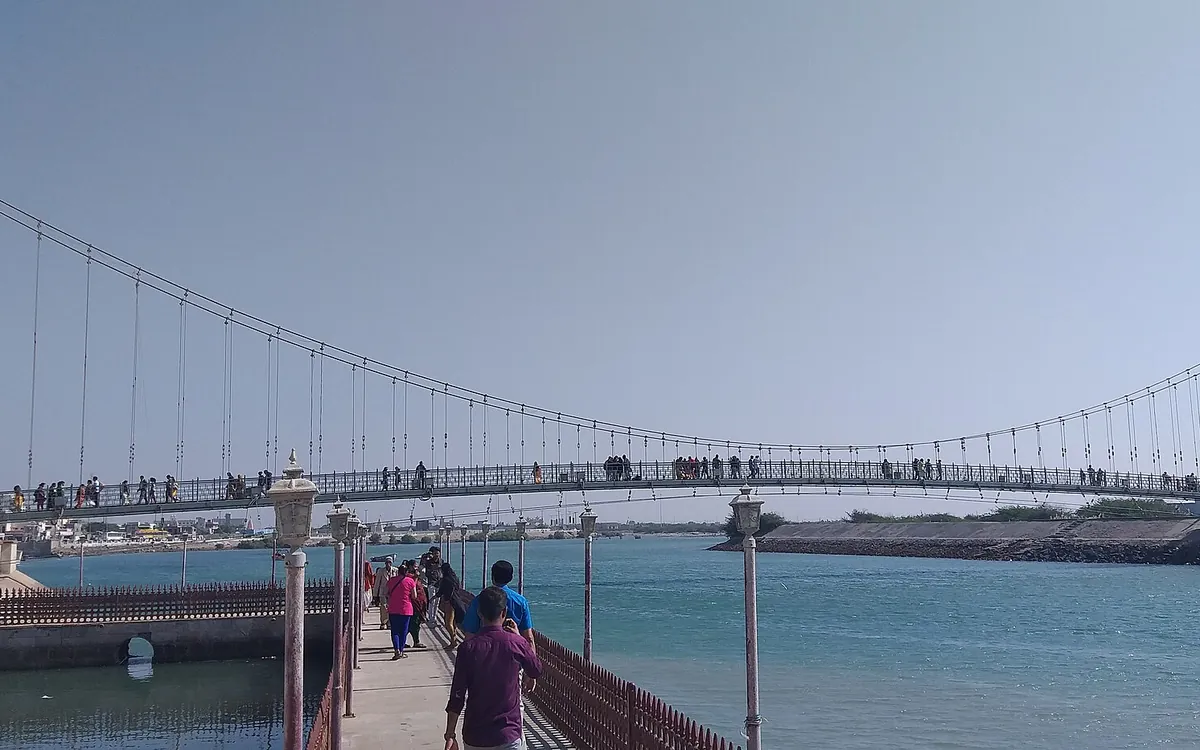
Sudama Setu is a pedestrian suspension bridge spanning the Gomti River at its mouth, where the river meets the Arabian Sea near Dwarka town. The bridge is named after Sudama, the childhood friend of Lord Krishna whose story of devoted friendship and divine grace is one of the most beloved narratives of the Bhagavata Purana. Sudama, a poor Brahmin, walked to Dwarka to visit his old friend Krishna who had by then become the king. Despite arriving with nothing but a small gift of flattened rice (poha), he was received with great honour by Krishna. When Sudama returned home, he found his humble hut transformed into a palace, Krishna had silently repaid his friend's love.
The choice of Sudama's name for this bridge is fitting in a way that goes beyond sentiment. The bridge connects the two banks of the Gomti, one leading to the town and railway station, the other closer to the seafront and temple area. Pilgrims crossing the bridge are, in a sense, making the same crossing that Sudama made: approaching the city of Krishna with devotion and some measure of hope. The bridge sways gently underfoot (as suspension bridges do) and many first-time visitors grip the cable railings with a mixture of nervousness and delight.
The bridge itself is a relatively modern structure built by the Gujarat government to ease pedestrian movement between the two banks of the Gomti near its tidal mouth. Entry is free and it is open from early morning until late evening. It is not a large bridge, the span is modest, but its elevation above the river is sufficient to provide genuinely outstanding views of the Gomti Ghat, the kunds, the sea and the temple. Many visitors spend more time on the bridge than they expect, stopping to photograph and simply stand with the wind in their faces and the whole sacred landscape spread below them.
What You See from the Bridge
From the midpoint of Sudama Setu, the view opens in all directions. Looking east (upstream along the Gomti), you see the river winding through the town with the Gomti Ghat steps descending to the water on both banks. The 56 kunds, sacred bathing tanks traditionally associated with the 56 ghats of Dwaraka mentioned in the Bhagavata, are visible as stone-lined rectangular or stepped structures along the riverside. Pilgrims can be seen bathing in the Gomti at various points, particularly in the early morning hours before darshan. The sound of water and the distant ring of temple bells carry across the river at this hour.
Looking west (downstream) from the bridge, the Gomti meets the Arabian Sea at the tidal mouth. At low tide, the sandbar at the confluence is visible and the water becomes shallow before deepening into the sea. At high tide the confluence is a single body of water with no clear boundary, the river loses itself in the sea in a way that mirrors the philosophical concept of the individual soul merging with the infinite. Gomti Ghat itself, the primary ritual space of this confluence, is visible directly below and to the south-west of the bridge. The lamps floated on the water during evening aarti are launched from the ghat directly below the bridge's sightline.
Looking north-east from the bridge, the Dwarkadhish Temple shikhara appears above the roofline of the town. At 43 metres it dominates the skyline of Dwarka from almost any vantage point and from the bridge it appears framed between the river and the sky. Early morning light, before 8 AM, turns the shikhara to gold and the image is remarkable. Photography from the bridge at this hour is among the finest opportunities in all of Dwarka for capturing the temple's character without the visual clutter of the bazaar and the crowds that surround it at ground level.
The Route from Bridge to Temple: 0.8 km Walk
After crossing Sudama Setu, continue on foot toward Dwarkadhish Temple. The route from the far (temple-side) end of the bridge to Swarga Dwar (the main temple entrance) is approximately 0.8 km and takes about 10 minutes at a comfortable walking pace. The path follows the Gomti riverbank lane heading east, you walk with the river on your left and the old town buildings on your right. This lane is narrower and quieter than the main bazaar road, giving it a distinctly different character from the more commercial route from the railway station.
Along this riverbank lane you pass small shrines to various deities, Hanuman, Ganesha and several Shiva lingas installed in alcoves in the walls. There are chai stalls, flower sellers and a few local residents going about their morning routines. The lane connects to the broader temple precinct area after about 600 metres, where it opens onto the wider space near Swarga Dwar. The remaining 200 metres to the gate is through the outer temple approach, past the shoe counters and the flower and prasad sellers who line the final approach to every major Hindu temple.
This Sudama Setu to Dwarkadhish route via the riverbank lane is notably less crowded than the main bazaar route from the railway station. If you are staying on the west side of the Gomti (where several dharamshalas and guest houses are located) or if you come from Gomti Ghat after a morning bath, this is the most natural walking route to the temple. It avoids the commercial density of the main bazaar while keeping you in the character of the pilgrimage town throughout the walk.
Combining Sudama Setu with Gomti Ghat
Sudama Setu and Gomti Ghat are natural companions, they are 200-300 metres apart and together make up the most atmospheric corner of Dwarka outside the main temple. The sequence that works best: begin at Gomti Ghat (accessible from the temple side via the riverside lane or from the seafront promenade), bathe in the Gomti if you wish (a ritual bath here is considered meritorious before Dwarkadhish darshan), then walk to Sudama Setu for the elevated view, cross the bridge and return via the far bank, then take the riverbank lane back to Swarga Dwar for temple darshan.
This loop, Gomti Ghat, Sudama Setu, riverbank walk to temple, takes about 45 minutes to an hour at a comfortable pace and covers the most sacred geography of Dwarka's riverfront. In the evening, the sequence runs in reverse: temple darshan, walk to Gomti Ghat for the Sandhya Aarti, walk to Sudama Setu to see the lamps floating on the water from above, then cross back to the far bank for dinner or return to accommodation. Both sequences are used by regular Dwarka visitors and both work beautifully.
During the Sandhya Aarti at Gomti Ghat, standing on Sudama Setu provides an elevated view of the aarti ceremony below, the priests with their lamps, the devotees on the ghat steps, the floating diyas moving on the current. It is a different perspective from being on the ghat itself and both perspectives are worth experiencing on different evenings if you are in Dwarka for more than one night. The combination of Gomti Ghat and Sudama Setu is one of those compound experiences that makes Dwarka more than just a temple visit.
Best Time to Visit Sudama Setu
The bridge can be visited at any time during daylight hours but two windows are outstanding. The first is early morning, between 6 AM and 8 AM when the light is at its most beautiful quality and the river and ghat have their quietest, most contemplative atmosphere. Pilgrims bathing in the Gomti below, the morning puja sounds drifting across the water, the golden light on the shikhara, all of this is at its richest before the crowds build up. After this bridge visit you walk 10 minutes to Dwarkadhish for the morning darshan, making the whole morning sequence feel continuous and unhurried.
The second outstanding window is the hour before sunset, golden hour. The Gomti Ghat steps in warm evening light, the sea beyond catching the last of the sun, the shikhara in silhouette or warm stone tones depending on your angle, this is the photographic highlight of any Dwarka visit. The evening also brings the aarti preparation at Gomti Ghat, which you can observe from the bridge before descending to participate at ground level. The Sandhya Aarti at the ghat typically begins at or just after sunset, so timing your bridge walk for 30-45 minutes before sunset gives you the light plus the aarti.
Midday visits (11 AM to 3 PM) are less rewarding, harsh overhead light, more heat, and the bridge can feel uncomfortably warm in summer. Monsoon season (July-August) brings a different character to the bridge: the Gomti rises significantly during heavy rain and the confluence with the sea can be dramatic and turbulent. The bridge itself is safe but the ghat steps below may be submerged. If you are in Dwarka during the monsoon, the bridge is actually an excellent vantage point for seeing the rain-swollen Gomti.
Frequently Asked Questions
Also Read
Rajkot Airport
Rajkot Hirasar Airport to Dwarkadhish Temple is approx 260 km (4.5-5 hrs) via NH51 through Jamnagar.
Read Full GuideStation to Temple
1 km from the station to Swarga Dwar: 10 minutes on foot through the bazaar, or 5 minutes by auto at ₹30-50.
Read Full GuideBhadkeshwar to Dwarkadhish
Bhadkeshwar Mahadev is about 2 km from Dwarkadhish Temple.
Read Full GuideSudama Setu Dwarka
The full story of the suspension bridge, its naming after Sudama, the views from above, and how to make the most of a visit to this Dwarka landmark.
Read MoreGomti Ghat Dwarka
The sacred river-sea confluence, the 56 kunds, and the Sandhya Aarti that makes an evening at Gomti Ghat unforgettable.
Explore GhatDwarkadhish Temple
History, architecture and darshan details of the main temple of Dwarka, the Jagat Mandir and its 72-pillared sabha mandap.
Read More